
Das Klinikum
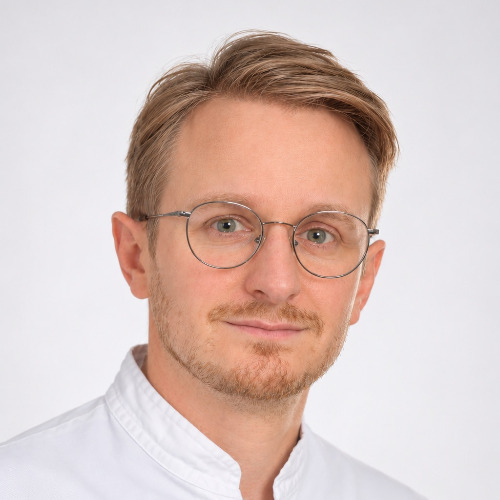
Dr.Dr. Michael Vollmer
Assistenzarzt
Leitung der Sprechstunde für kindliche Schädeldeformitäten, Klinik für MKG-Chirurgie, UKT (seit 2022)
Kontakt
Telefonnummer: 07071 29-85150
E-Mail-Adresse: michael.vollmer@med.uni-tuebingen.de
Klinik / Institut / Zentrum
Klinische Schwerpunkte
- Mund-Kiefer und Gesichtschirurgie, plastische Operationen
Ausbildung & beruflicher Werdegang
-
01.2020 - 12.2021wissenschaftlicher Mitarbeiter der Universität Heidelberg in der Abteilung für Mund-Kiefer und Gesichtschirurgie
-
seit 01.2022Assistenzarzt Universität Tübingen in der Abteilung für Mund-Kiefer und Gesichtschirurgie
-
07.2021Zertifizierung klinischer Prüfarzt
-
2025Zertifizierung Tierkundlicher Kurs
Publikationen
- Automated Assessment of Radiographic Bone Loss in the Posterior Maxilla Utilizing a Multi-Object Detection Artificial Intelligence Algorithm DOI: 10.3390/app13031858
- Associations between periodontitis and COPD: an artificial intelligence-based analysis of NHANES III DOI: 10.3390/jcm11237210
- Artificial Intelligence-Based Prediction of Oroantral Communication after Tooth Extraction Utilizing Preoperative Panoramic Radiography DOI: 10.3390/diagnostics12061406
- Deep learning on BCC in vivo reflectance confocal microscopy data. Pre-studies on algorithms DOI: 10.3390/jpm12091471
- Ex vivo fluorescent confocal microscopy images of oral mucosa: tissue atlas and evaluation of the learning curve DOI: 10.1002/jbio.202100225
- Deep learning on oral squamous cell carcinoma ex vivo fluorescent confocal microscopy data: a feasibility study DOI: 10.3390/jcm10225326
- In vivo reflectance confocal microscopy of wounds: feasibility of intraoperative basal cell carcinoma margin assessment DOI: 10.21037/atm-21-3462
- Mandibular Brown Tumor as a Result of Secondary Hyperparathyroidism: A Case Report with 5 Years Follow-Up and Review of the Literature DOI: 10.3390/ijerph18147370
- Feasibility and Implementation of Ex Vivo Fluorescence Confocal Microscopy for Diagnosis of Oral Leukoplakia: Preliminary Study DOI: 10.3390/diagnostics11060951
- Detection of oral squamous cell carcinoma with ex vivo fluorescence confocal microscopy: Sensitivity and specifity compared to histopathology DOI: 10.1002/jbio.202000100
- Features of oral squamous cell carcinoma in ex vivo fluorescence confocal microscopy DOI: 10.1111/ijd.15152
- Performance of artificial intelligence-based algorithms to predict prolonged length of stay after head and neck cancer surgery doi: 10.1016/j.heliyon.2023.e20752. eCollection 2023 Nov.
- Realizing in-house algorithm-driven free fibula flap set up within 24 hours: a pilot study evaluating accuracy with open-source tools doi: 10.3389/fsurg.2023.1321217. eCollection 2023.
- Multimodal artificial intelligence-based pathogenomics improves survival prediction in oral squamous cell carcinoma doi: 10.1038/s41598-024-56172-5.
- Automatic Apparent Nasal Index from Single Facial Photographs Using a Lightweight Deep Learning Pipeline: A Pilot Study doi: 10.3390/medicina61111922.
- Quantifying the Oral Cancer Public Awareness Deficit in Germany (2015-2023) doi: 10.3390/cancers18081236.
- Demographic prompt cues shift clinical recommendations in multimodal large language models: a multi-model audit of 25,380 dental radiograph assessments doi: 10.1186/s12903-026-08644-5.
- Inverse relationship between neoantigen clonality and T-cell activity reveals distinct immune phenotypes in HNSCC doi: 10.1186/s12967-026-08371-