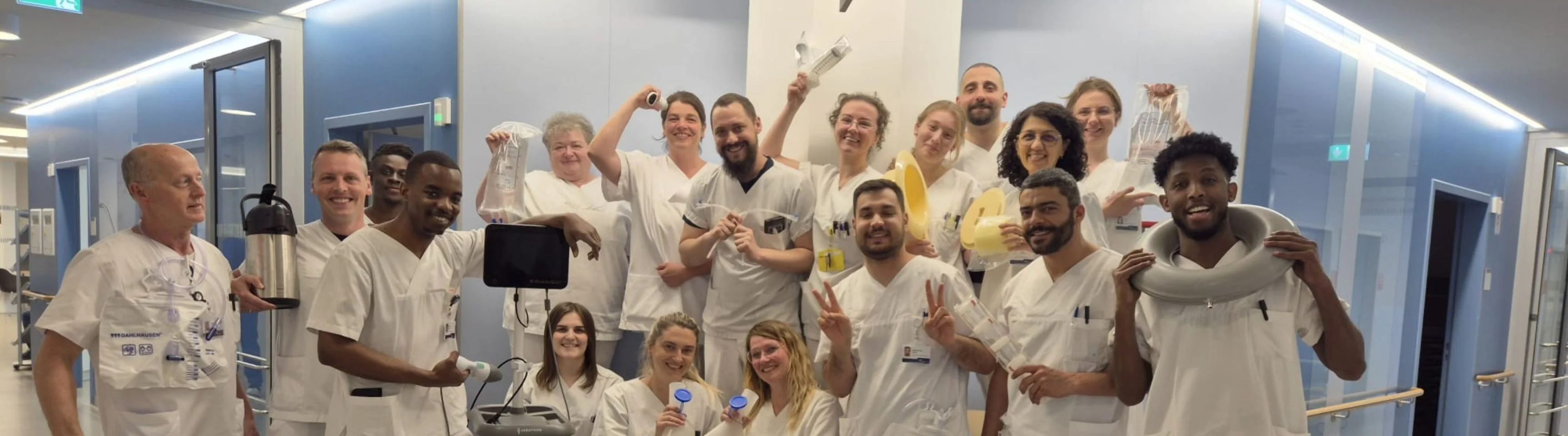

Two
Departments, One Team

45
Beds

479
Total years of Uro experience

41 years
Employees with the longest tenure at Uro

57.8 L
Average Urine Volume in 24 Hours

Our Team
MFAs, geriatric care workers, GuKPHs, PFPs, and IPPs.

46
Employees with a workload ranging from 20% to 100%
5 Questions for …
We start by assigning rooms together on the planning board, followed by the handoff from the night shift. Next, we go to the patients to check their vital signs, administer medications, and distribute antibiotics and IVs. This is followed by rounds with the doctors and documenting the findings. After our break, we provide patient care (basic and specialized care, such as changing dressings, removing drains, etc.) and handle patient discharges and admissions.
2. What are your thoughts on interdisciplinary collaboration in urology?As a rule, working together as equals works very well, but of course it always depends on you how well communication—and thus the collaboration—works.
3. In your opinion, what distinguishes urology from other surgical departments?Given the nature of the field, a high degree of sensitivity is required in day-to-day work.
4. You've been working in urology since April 2009. Why?For me, it all started with the positive experiences I had during my internship. But even today, I enjoy almost every workday just as much as I did back then.
5. What are the benefits of working in urology?We have relatively flat hierarchies here, and the atmosphere is often almost like family. Although we have a high patient turnover, this also means we provide significantly more specialized care than in other fields.
We offer modern diagnostic services, surgical and minimally invasive procedures, and oncological treatment plans.
Join the team!
Get in touch with our representatives or apply for one of our current job openings!
Learn more
You can find more photos and information about the station on our website.
Our Contacts