Telefonnummer: 07071 29 73682


Adresse: Geissweg 5/1
72076 Tübingen
Mailing address


About

The Master of Science in Molecular Medicine at the Eberhard Karl University of Tübingen – Germany – is a one-year course-based Master’s program that will enhance students’ discipline-specific knowledge and skill set towards an in-depth, advanced skill set and increased students’ research literacy.

Eckdaten zum Studiengang

1 Year

Duration

15 April

Application Deadline

1st October

Start Date

Tübingen, Baden-Württemberg

Campus Location

Site plan

Video

Why Molecular Medicine in Tübingen

In the video, a student explains why she decided to study molecular medicine.

Overview

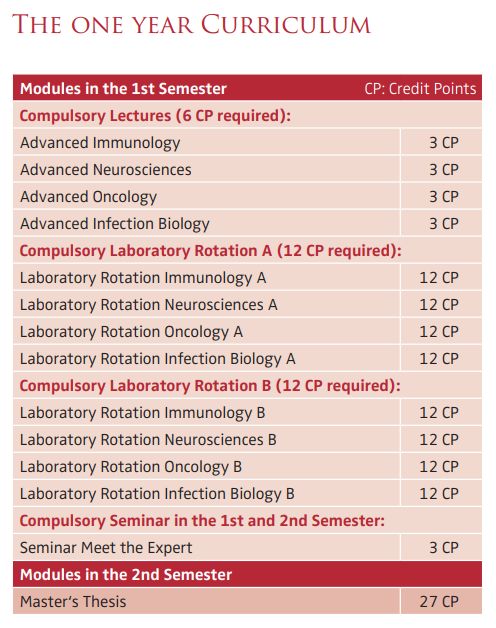
The Master’s program lasts one academic year (two semesters) and encompasses a total of 60 ECTS. The one year curriculum is divided into two main parts, the first concentrating on deepening knowledge and advanced laboratory research training, the second on an individual research project (= Master’s thesis).

In the first semester, students can choose from a catalogue of modules in two selected areas of specialization allowing the student to tailor the program to their individual interests. A total of 5 modules (33 ECTS) must be taken.

Courses and lectures in Infection Biology, Oncology, Neurosciences and Immunology are available as areas of specialization.

The Master’s thesis Research Project (27 ECTS) in the second semester forms a major component of the course and entails six months’ full-time practical work in the laboratory on an autonomous research project. This element gives students experience in independently solving a scientific problem within the field of modern biomedical research and how to write a scientific publication.

Specific information about the degree program

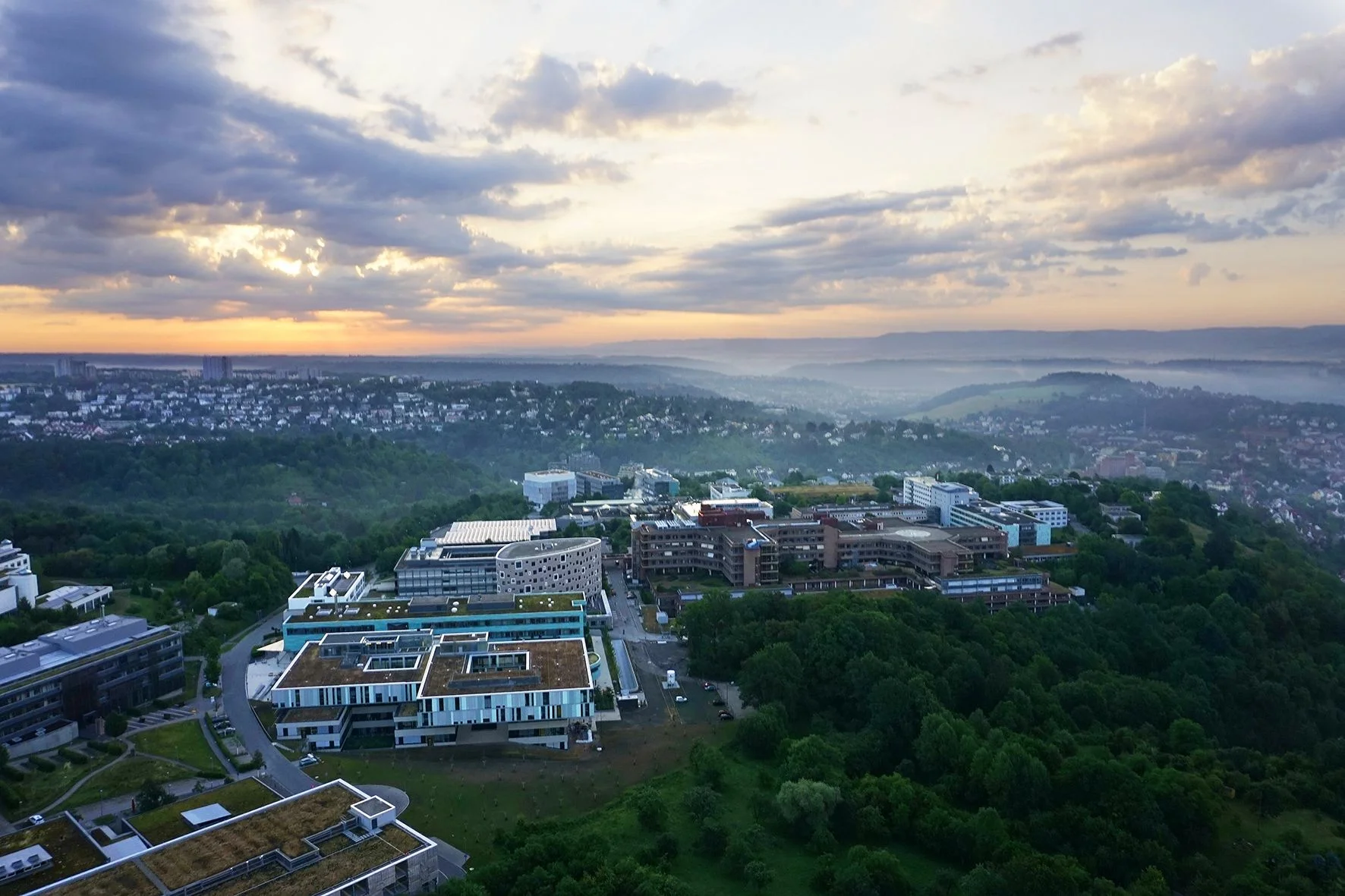
Campus

The campus inspires research, student learning experience, and advances sustainability. The buildings and spaces support how we learn, experiment, collaborate, teach, and work.

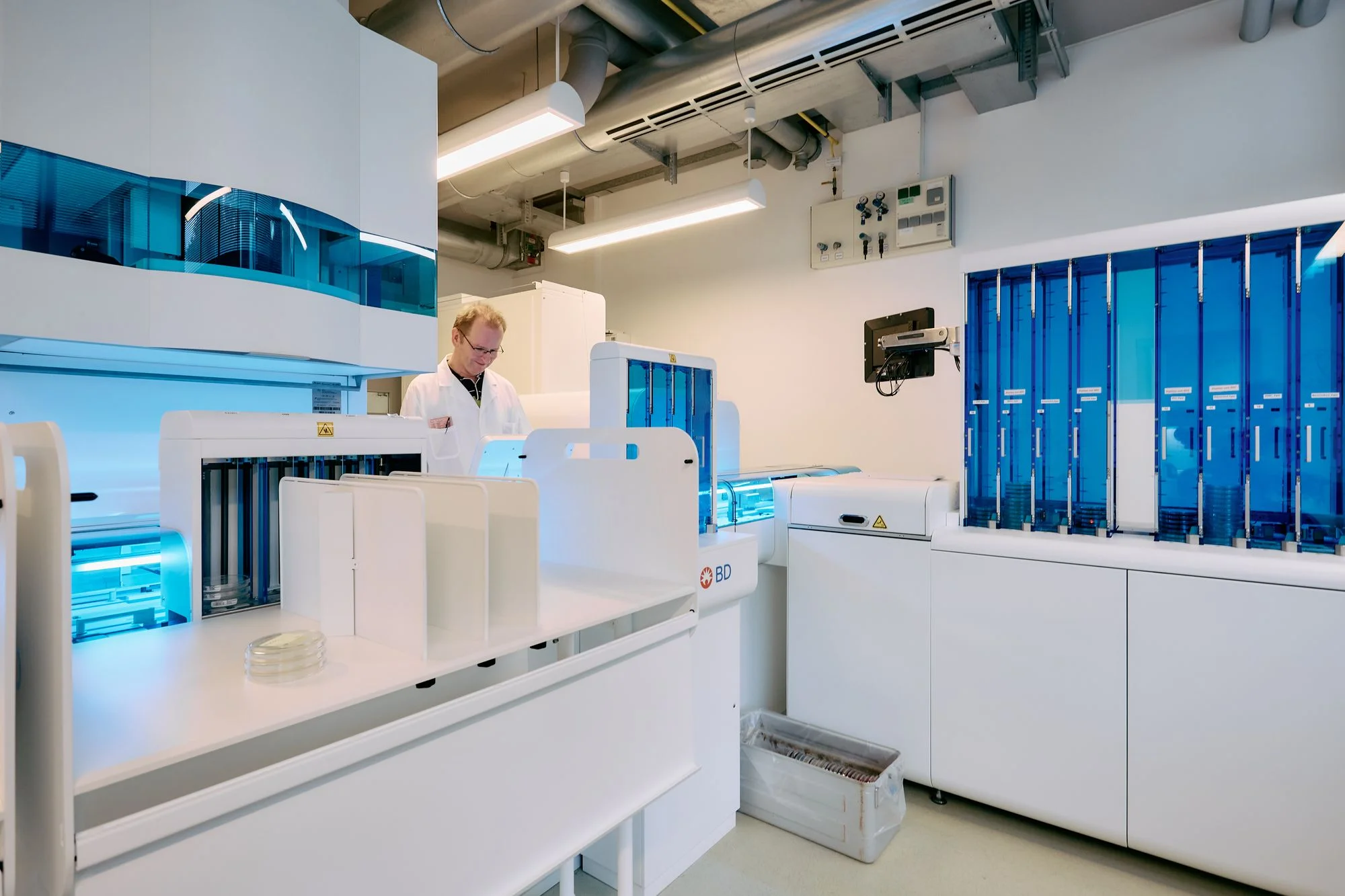
You will study in modern lecture halls and benefit from an inspiring learning atmosphere. As part of a research-oriented medical faculty, you will have access to extensive libraries, modern laboratories, and interdisciplinary networks.

Practical training

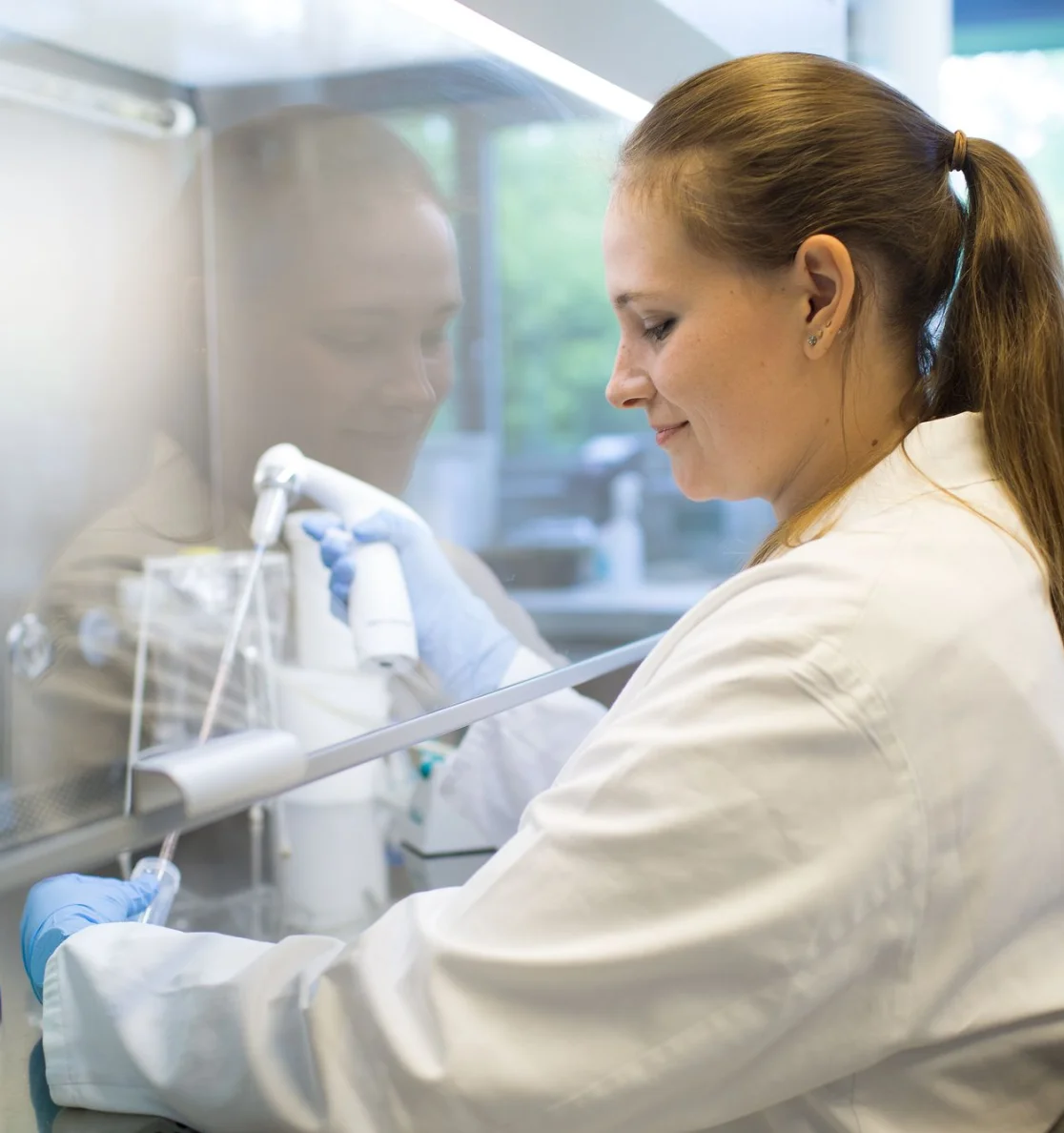
Before deciding on a master's thesis in your field of interest, you will train important core biomedical skills in a microproject during two six-week lab rotations of your choice: Independent planning and execution of experiments for a specific research question, learning a particular technique, evaluation and documentation of results, troubleshooting, teamwork, literature research, and presentation of results in the working group and a student seminar.

Discipline-specific knowledge and a good skill set in Molecular Medicine Basic are key prerequisites for a good fit for this program.

Testimonials

Faszinierende Welt der Wissenschaft

„Nach dem Erwerb des Abiturs verfolgte ich das Ziel, im Bereich der Medizin tätig zu bleiben. Durch das Studium der Molekularen Medizin im Bachelor- und Masterstudiengang habe ich mich in die faszinierende Welt der Wissenschaft vertieft, die Medizin und Forschung miteinander verknüpft, und gewann ein umfassendes Verständnis der grundlegenden Prinzipien des Lebens. Das breite Angebot an Bachelor-Modulen in verschiedenen biomedizinisch relevanten Fächern ermöglichte es mir, mich nicht auf einen bestimmten Bereich zu beschränken. In den Praktika lernte ich systematisch zu denken, Hypothesen zu formulieren, meine Ergebnisse mit aktuellen Theorien zu verknüpfen und das Erlernte interdisziplinär anzuwenden.
Ausschlaggebend für meine Begeisterung für die Wissenschaft waren vor allem die lehrreichen Praktika, insbesondere die Auslandspraktika, in denen ich an verschiedenen Organismen wie Mensch, Hefe, Insekten und Mäusen sowie zu Themen wie radioaktiver Strahlung und Hautkrebs forschen durfte. Im Master spezialisierte ich mich aufgrund der starken Praxisorientierung auf die Krebsimmunologie, um zu verstehen, wie das Immunsystem gezielt zur Krebsbekämpfung eingesetzt werden kann.
Das Studium hat mir nicht nur wertvolle Erkenntnisse für meine berufliche Laufbahn vermittelt, sondern auch meine Sichtweise auf das Leben und dessen Verständnis entscheidend geprägt. Neugier, Offenheit, Geduld und Wissensdurst gehören zu diesen wichtigen Eigenschaften, die mir das Studium vermittelt hat. Zusammenfassend lässt sich sagen, dass Molekularmediziner: innen aufgrund ihrer breit gefächerten Fähigkeiten, ihrer Interdisziplinarität und ihres Fokus auf medizinische Forschung während und nach dem Studium vielfältige Perspektiven offenstehen."

Mustafa Kilic

Degrees and Career Opportunities

The Master’s program in Molecular Medicine lasts one academic year and leads to a Master of Science (M. Sc.) degree. Upon successful completion of the program, graduates may choose to continue their studies by directly pursuing a doctorate or PhD in Molecular Medicine. Alternatively, graduates may choose to embark upon a professional life.

Professorinnen und Professoren

Dean of Studies

Deputy Dean of Studies

Stellvertretende Studiendekanin

Prof. Dr. med., Ph.D. Julia Skokowa

Platzhalter für Statement

Platzhalter für Statement

Do you have any questions?

Our program coordinator will be happy to assist you with any questions you may have about the Master's program in Molecular Medicine.

Dr. Konstanze Muschko (Pronouns: she/her)

Program Coordinator
M.Sc. Molecular Medicine

Telefonnummer: 07071 29-73682

E-Mail-Adresse: Send Email

Öffnungszeiten: Office hours: by appointment

Maike Gernhöfer

Program Coordinator
M.Sc. Molecular Medicine

Telefonnummer: 07071 29-77932

Are you interested?

Please familiarize yourself in advance with the most important key data about the program and the application process:

To the University of Tübingen program  Apply now

FAQ

The selection regulations require a four-year bachelor's degree in the subject Molecular Medicine (or comparable) with 240 ECTS.

The selection regulations require a four-year bachelor's degree in the subject Molecular Medicine (or comparable) with 240 ECTS.

No, that is not possible.

Yes, you must demonstrate knowledge equivalent to 6 ECTS credits in oncology, infection biology, neuroscience, and immunology. No exceptions are permitted.

Please compile the relevant evidence in a concise and meaningful manner. A reasonable guideline for a meaningful application is 20 pages.

Please do not submit complete module handbooks and/or complete publications.

Please compile the relevant evidence in a concise and meaningful manner.

Please do not submit complete module handbooks and/or complete publications.

If your degree certificate does not contain a detailed list of relevant modules, you have completed and the credits you have earned for each module, please submit an additional document from your university along with your degree certificate, transcript and diploma, e.g., an overview of your module achievements or a certificate stating the subjects and total number of hours.

The semester begins on October 1.

We highly recommend arriving during the first week of October so that you can attend the introductory events for the winter semester and familiarize yourself with the new environment and campus.

Please follow the link for more information on tuition fees.

Study abroad

Studying abroad during your degree? Here's what you need to know!

The master's program in molecular medicine lasts one year. An option for a stay abroad is available in the second semester, which is reserved for the six-month master's thesis. The master's thesis can be written abroad after consultation with the examination office. 

Please contact the program coordinator and your examination office in good time.

Dr. Konstanze Muschko (Pronouns: she/her)

Program Coordination

Telefonnummer: 07071 29-73682

E-Mail-Adresse: Konstanze.Muschko@med.uni-tuebingen.de

Dipl.Biol. Maike Gernhöfer

Examination office

Telefonnummer: 07071 29-77932

E-Mail-Adresse: exam.molmed@med.uni-tuebingen.de

  • Students apply directly by the research institutions or companies of their choice. Once you have found a suitable topic and supervisor abroad, you need the written consent of the chair of the examination board (application by email with details of the project, the supervisor, and a list of publications).
  • Theses are reviewed according to the rules of the University of Tübingen, i.e. you need two examiners from the University of Tübingen for the evaluation. To find an examiner, please contact a professor that matches the topic of your thesis.

As the application takes place on individual basis, there is no strong deadline. We advise to start application 6 to 8 months before the expected start of the practical work experience.

Students of the Molecular Medicine M.Sc. could apply for the Erasmus-/CIVIS Exchange Program. 

Please apply by the Department of Studies and Teaching (Dr. Elena Lebherz) by the deadline with the following application documents:

  • Letter of motivation (in English, max. 1 page)
  • Curriculum vitae (in English, in tabular form)
  • Proof of extracurricular activities (optional)
  • Transcript of records (including average grade)
  • The selection process is based on the student's grades.
  • It will also be taken into account that the selected candidate will represent the Faculty of Medicine abroad and play a significant role in shaping the future of their successors.
  • Application Deadline for the next academic year is the 31 of January.
Additionally, to the ERASMUS-Exchange CIVIS offers a wide range of exchange opportunities, like Summer and Winter Schools, BIPS, COILS etc. 


Please find more Information about the Current CIVIS Exchange Opportunities 


The List of the CIVIS- and Erasmus-Partners could be found here.