From Tübingen to Tokyo with InfecTT – Part 2
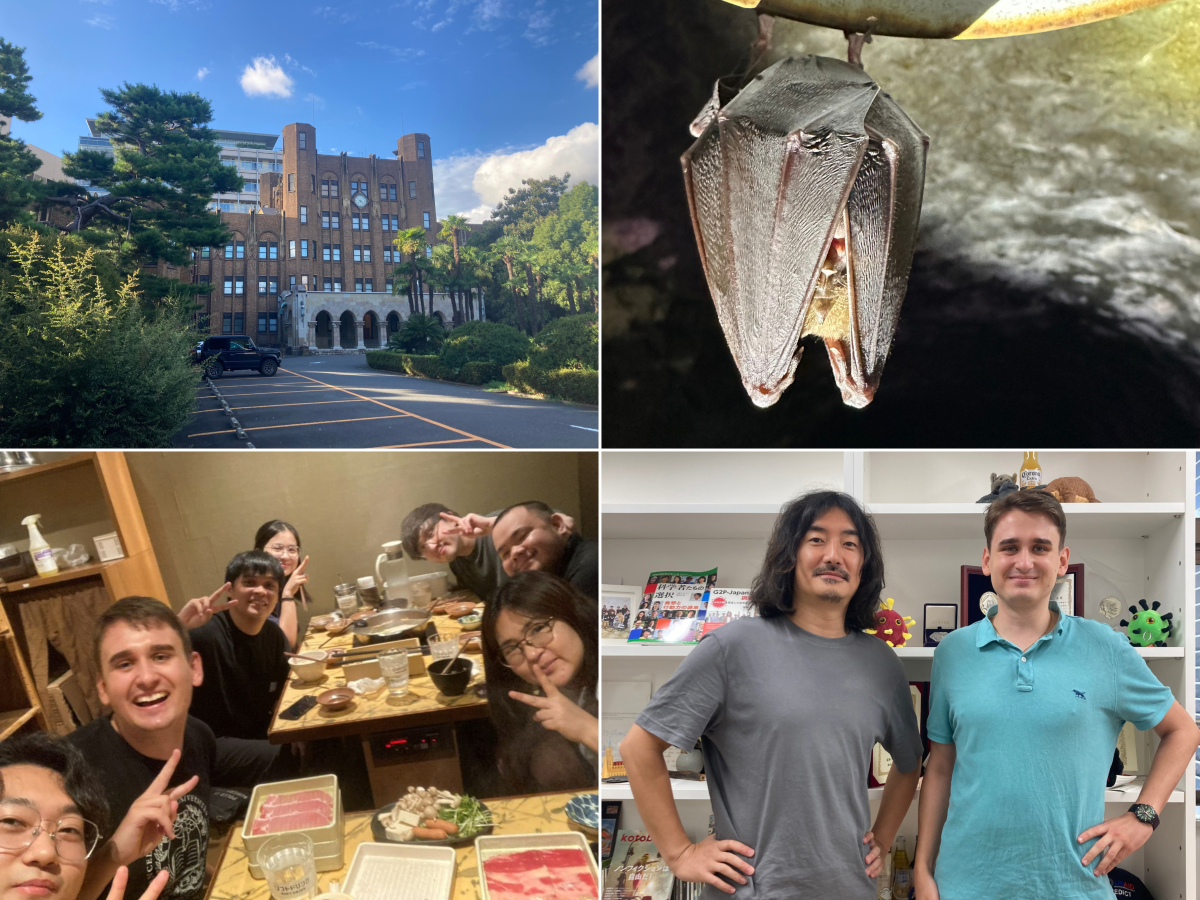
...and that’s how my lab exchange at the Sato Lab began. During the first few days, I was mainly busy familiarizing myself with my research project and getting to know all the staff members. What immediately struck me was how international the group is. Although about half of the staff members are from Japan, numerous other nationalities are represented. Leading the way is China with five researchers, followed by Thailand, Indonesia, Bangladesh, and the Philippines, each with one or two staff members. At first, it was unusual for me that I was the only European, but that changed after just a few weeks when a French postdoc joined the lab. Fortunately, since the group is so international, the main working language is English - a given for research groups in most European countries, but not in Japan, where many labs are still exclusively Japanese.
As one of the most renowned virology research groups in Japan, the Sato Lab is quite large: It employs a total of nearly 30 staff members, including 8 postdocs and 6 technical assistants alone. The group’s research is correspondingly broad in scope. It can be divided into three main areas: cell culture research, animal experiments, and bioinformatics, covering a large variety of virological research methods. Each area is primarily overseen by one or two postdocs, who in turn supervise PhD and master’s students. At the same time, there is a great deal of collaboration between the different areas, as most projects follow an interdisciplinary approach. Furthermore, it is very common for staff members to work on multiple projects simultaneously: while master’s students are usually involved in 2-4 projects, some postdocs work on up to 10 projects at the same time.
The Sato Lab has gained international recognition, particularly during the COVID-19 pandemic. Some of its research findings have even been incorporated into official briefings of the World Health Organization, for example with regard to the Omicron variant. In addition to numerous collaborations with other research groups and work on current virological issues, coronavirus research has remained a central focus of Professor Kei Sato’s work to this day. Meanwhile, the scope of this research has gradually expanded: Apart from SARS-CoV-2, the group now also studies related coronaviruses that circulate primarily in bats as a natural reservoir. There, a key focus is to gain a better understanding of which genetic changes may have enabled the virus to transmit to humans.
In collaboration with research laboratories in Southeast Asia, samples from bats are collected and subsequently analyzed for coronaviruses and the genetic characteristics of their hosts. By analyzing samples from various regions and countries, the goal is to develop an increasingly comprehensive picture of the viruses circulating there and their genetic diversity. Comparing viral sequences with the receptor molecules of the respective hosts (particularly ACE2) enables the group to investigate connections between the evolution of the viruses and their hosts. This approach thus combines the study of the viruses themselves with an analysis of their interactions and their evolutionary adaptation to their respective hosts. In modern virology, such integrative approaches are increasingly grouped under the term “systems virology.” In the long term, the insights thus gained may help to better predict virus variants that could pose a threat to humans in the future. This would enable earlier identification of these threats and the development of more targeted measures to prepare for emerging virus variants.
The two research projects I am involved in are also part of this overarching approach. In the first project, I am investigating which cellular factors influence the replication of SARS-CoV-2 in bat cells. This is based on the observation that this virus is known to replicate only poorly in bat cells. To investigate possible causes for this, the cells should be modified to express the TMPRSS2 protein in addition to the already present surface receptor ACE2. TMPRSS2 plays an important role in activating the SARS-CoV-2 spike protein, thereby facilitating the virus’s entry into the cell. The cell model thus established will subsequently be used to investigate the molecular causes of the low replication of SARS-CoV-2 in bats. For the second project, I am involved in one of the lab’s international collaborations: Together with two other colleagues, my task is to develop a protocol that will enable the sequencing of ACE2 genes from bat swabs collected in Bangladesh. This will then allow us to investigate the coevolution of the virus and its host in this bat population.
Fortunately, my transition into the lab went very smoothly: Since I was already familiar with many of the methods and procedures from my time in Tübingen, I quickly found my way around. Whenever I had questions or encountered problems, my colleagues were always there to offer advice and support. This allowed me to get up to speed quickly and work largely independently after just a few weeks.
In fact, I felt right at home in the lab after just a short time, largely thanks to the friendly and collegial atmosphere. In addition to having lunch together (we usually make use of the rotating selection of food trucks on campus), group activities are frequently organized after work, such as cinema visits and karaoke nights. A special highlight for me was a welcome party organized in the lab’s kitchen, which Professor Sato also attended. There, I got to try some Japanese specialties that were new to me, such as dried octopus, Japanese draft beer, and even the famous snake liquor. In general, eating together plays an important role in Japanese work culture, and in Tokyo the possibilities here are, of course, almost endless. And so we have already tried a wide variety of cuisines together: from Japanese hot pot and Chinese Sichuan cuisine to Korean barbecue, and even enjoyed a classic evening at an izakaya.
Of course, Tokyo has much more to offer than its diverse culinary scene. As a megacity and a major hub for culture, architecture, and history, it provides countless opportunities for leisure and weekend activities. In the final part of this blog post, I will take a closer look at some of these experiences, as well as my travels around Japan.