
New Journal of Hepatology Paper by Dr. Suchira Gallage and Prof. Dr. Mathias Heikenwälder
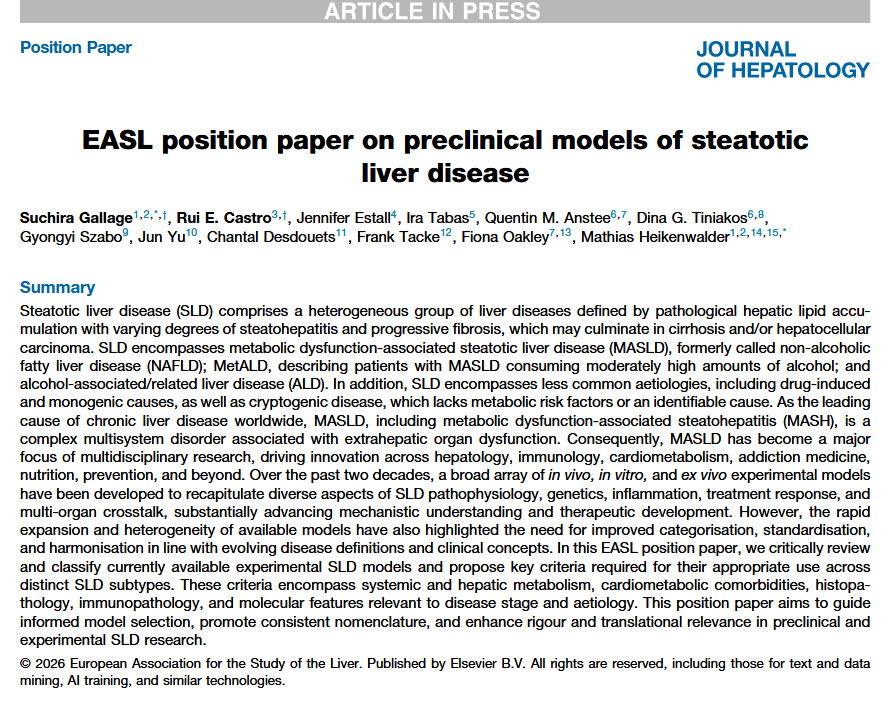
In this newly published EASL position paper in the Journal of Hepatology, Prof. Dr. Mathias Heikenwälder and Dr. Suchira Gallage together with other colleagues of the M3 Research Center and other institutions provide a comprehensive overview and classification of currently available experimental SLD models and propose practical recommendations for their appropriate use in research. The paper critically evaluates in vivo, in vitro, and ex vivo models and discusses their respective strengths and limitations across different SLD subtypes and disease stages.
Steatotic liver disease (SLD) has become one of the most important global health challenges and is now the leading cause of chronic liver disease worldwide. The condition encompasses a broad spectrum of diseases, including metabolic dysfunction-associated steatotic liver disease (MASLD), alcohol-associated liver disease (ALD), MetALD, and several less common forms linked to drugs, genetic causes, or unknown aetiologies. As research activity in this field has rapidly expanded over the past two decades, an increasing number of experimental models have been developed to study different aspects of disease biology, progression, and treatment response. However, the diversity and heterogeneity of these models have also created significant challenges regarding comparability, standardization, and translational relevance.
Importantly, the paper does not aim to identify a single “ideal” model. Instead, it emphasizes that model selection should always be guided by the specific scientific question being addressed. Different models capture distinct aspects of SLD pathophysiology, including hepatic lipid accumulation, inflammation, fibrosis, cardiometabolic dysfunction, immune responses, and multi-organ crosstalk. The recommendations therefore provide guidance on which experimental approaches are most suitable and which may be less appropriate depending on the underlying disease mechanism or translational objective.
The position paper also reflects the evolving clinical nomenclature and concepts surrounding SLD, particularly the transition from NAFLD to MASLD and the introduction of categories such as MetALD. To support greater consistency across the field, the recommendations propose harmonized criteria for evaluating experimental models, including metabolic features, histopathology, immunopathology, molecular signatures, and extrahepatic comorbidities.
Overall, the paper aims to improve rigour, reproducibility, and translational impact in preclinical SLD research. By providing a structured framework for model selection and classification, the recommendations are intended to support researchers across hepatology, immunology, metabolism, and related disciplines in designing more informative and clinically relevant studies.
Have a listen to the Podcast presenting this Paper: https://easlcampus.eu/tltm/episode-11
Reference:
Gallage, Suchira et al. “EASL position paper on preclinical models of steatotic liver disease.” Journal of hepatology, S0168-8278(26)00263-1. 27 May. 2026, https://doi.org/10.1016/j.jhep.2026.04.029