Dynamic interactions in metabolically relevant tissues

We are studying the dynamic interactions between tissue resident immune cells, stromal cells, and microbes in metabolically relevant tissues that interface with the environment. We use an interdisciplinary approach combining the fields of immunology, diabetology, and microbiology to increase the understanding of tissue-immune crosstalk and factors that dictate metabolic health and disease, including obesity, type 2 diabetes, and non-alcoholic steatohepatitis (NASH) in fatty liver disease. By integrating the abundant clinical resources of the University Hospital Tübingen, we aim to understand tissue immune cells in their local environment (niche), defined by specialized stromal cell subsets. For this, we pair advanced single-cell based techniques such as flow cytometric analysis and sorting with molecular techniques, including single-cell RNA sequencing and 3D volumetric imaging, allowing us to visualize and quantify complex immune and stromal cell topography in the context of metabolic diseases. 

Our research group is at the University Hospital Tübingen in the Department of Diabetology, Endocrinology, and Nephrology. We are affiliated with the M3 institute, the Institute of Diabetes Research and Metabolic Diseases (IDM), and the German Center for Diabetes Research (DZD). 
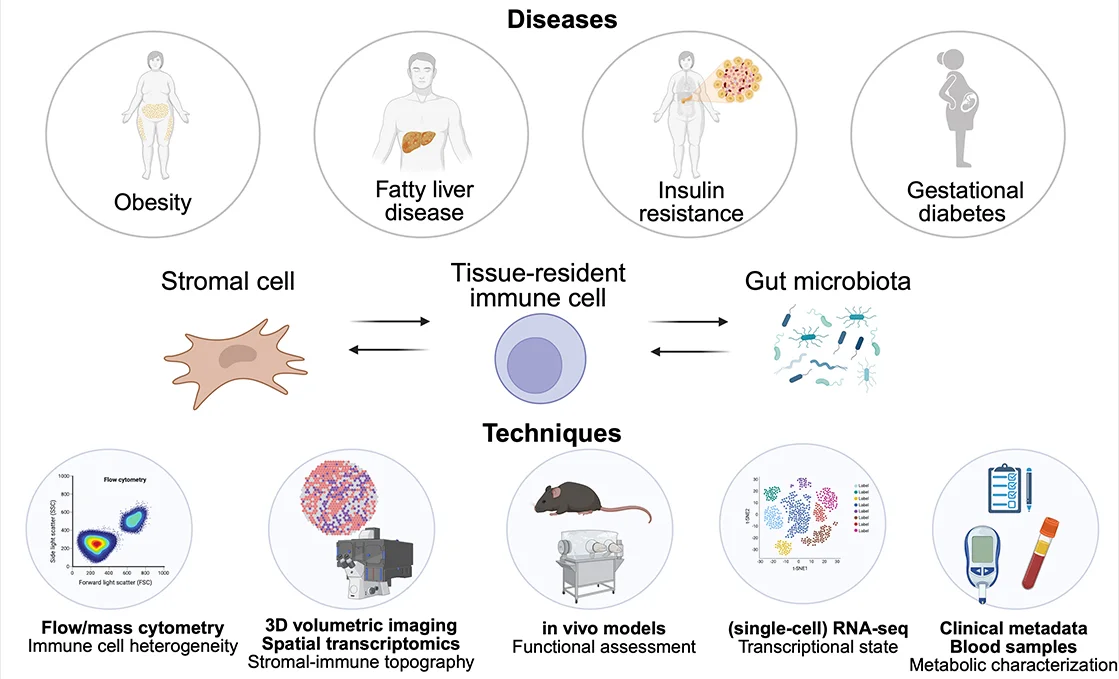

Wissenschaftliche Abbildung zum Text
Dr. med. Julia Sbierski-Kind

Dr. med. Julia Sbierski-Kind

Fachärztin für Innere Medizin und Endokrinologie und Diabetologie

Publications: Publications

Personenprofil: Mehr zur Person

Julia Sbierski-Kind received her state examination in medical studies from the Albert Ludwig University of Freiburg in 2013, and subsequently obtained her medical thesis from the University of Freiburg, working in the lab of Tobias Huber. During her doctoral studies, she focused on extrarenal expression of the slit diaphragm proteins NEPH1 and NEPHRIN. She started her residency in internal medicine and endocrinology at the Charité in Berlin and worked as clinician scientist under the mentorship of Joachim Spranger and Hans-Dieter Volk between 2014 and 2019. Here she focused on adaptive immune cells in adipose tissues and their adaptation to metabolic impairment (obesity and caloric restriction). For her postdoctoral studies, she joined the lab of Ari Molofsky at the University of California San Francisco in 2019. Here she examined the functional role of group 2 innate lymphoid cells (ILC2s) and their regulation of type 3 immune cells during obesity-induced non-alcoholic steatohepatitis (NASH) and liver fibrosis. She continued her fellowship in endocrinology and diabetes at the University Hospital of Munich (LMU) in 2021, after which she transferred to the University Hospital Tübingen in 2023 to establish her own research group. Her group is interested in how tissue resident lymphocytes and their crosstalk with stromal cells regulate the development of obesity-associated liver injury. She also engages in teaching at multiple levels, including medical students, and graduate students.

Interview

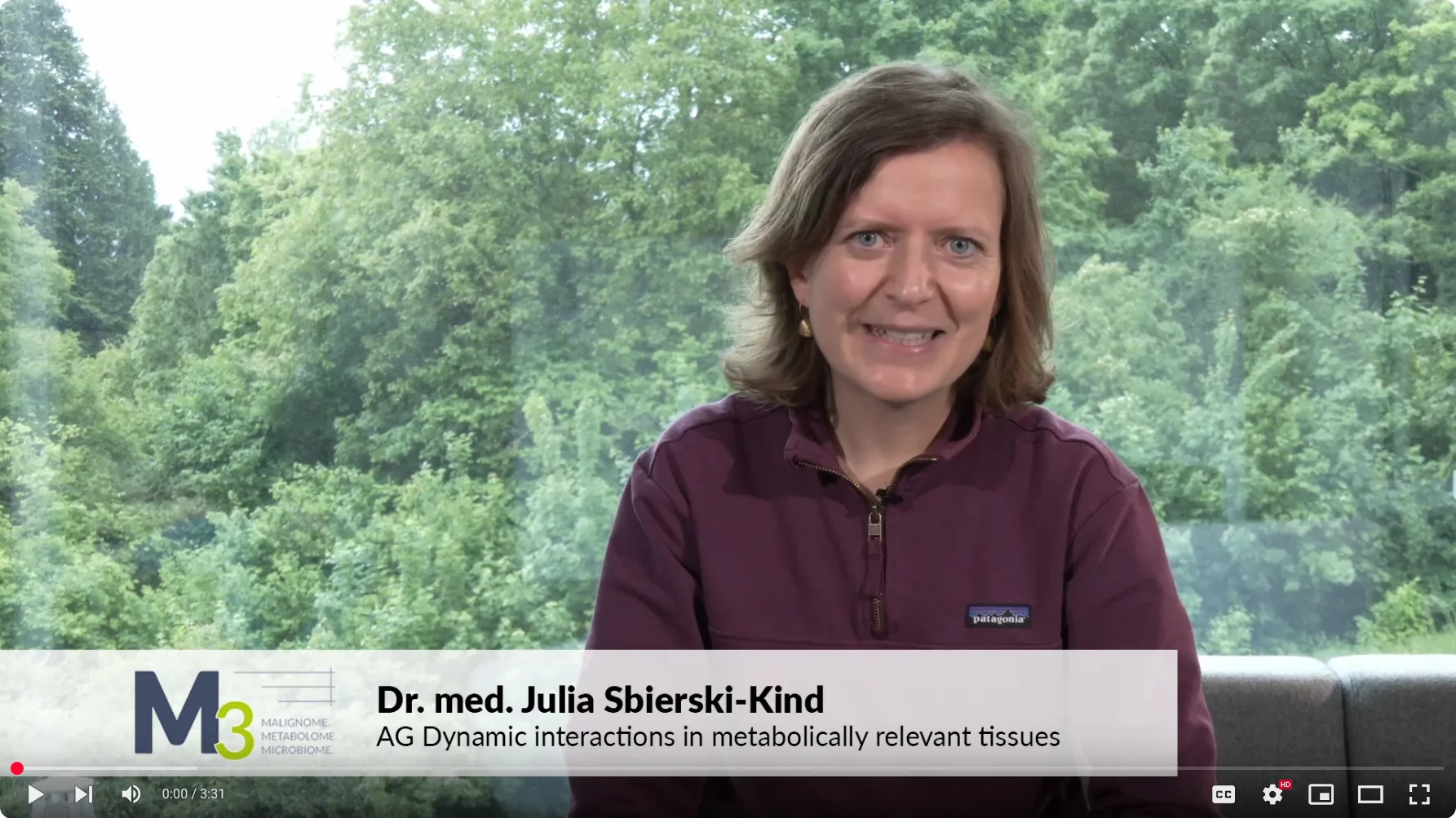
Dynamic interactions in metabolically relevant tissues: Interview with Dr. med. Julia Sbierski-Kind

At the interface of immunology, diabetology, and microbiology, this Dr. Sbierski-Kinds research group investigates how tissue-resident immune cells, stromal cells, and microbes interact in metabolically active tissues such as liver and adipose tissue. Using cutting-edge techniques, from single-cell RNA sequencing to 3D volumetric imaging , the team explores how local cellular environments influence metabolic diseases like obesity, type 2 diabetes, and NASH. Embedded within the University Hospital Tübingen and affiliated with the M3 institute, IDM, and DZD, the group benefits from unique clinical resources to decode tissue-specific immune responses in health and disease.

Beim Abspielen des Videos werden Daten an YouTube übertragen. Weitere Hinweise finden Sie in unserer Datenschutzerklärung.

tissue
resident immune cells
stromal
cells
metabolically
relevant tissues

Selected publications

  • 2026

    Type 2 lymphocytes restrict type 3 lymphocytes during liver fibrosis and colocalize in fibroblast niches

    Sbierski-Kind J, Cautivo KM, Nilsson J, Wagner JC, Dahlgren MW, Crystal NE, McClave M, Mroz NM, Ganslmeier M, Lizama CO, Gan AL, Matatia PR, Taruselli MT, Chang AA, Caryotakis S, O'Leary CE, Kotas M, Lee JH, Gu T, Seo H, Kim HJ, Mattis AN, Peng T, Locksley RM, Molofsky AB. Type 2 lymphocytes restrict type 3 lymphocytes during liver fibrosis and colocalize in fibroblast niches.
    Sci Adv. 2026 Mar 13;12(11):eaea6805. doi: 10.1126/sciadv.aea6805. Epub 2026 Mar 11. PMID: 41811951; PMCID: PMC12978224. https://doi.org/10.1126/sciadv.aea6805
  • 2025

    Systemic and SARS-CoV-2 specific Immune Disturbances in Individuals With Post-COVID Syndrome

    Veronica Ober, Felix Völk, Julia Sbierski-Kind, Eva Grüner, Renate Stirner, Gabriele Reiling, Svenja Feldmann, Gerardo Ibarra, Ulrich Seybold, Hans Stubbe, Kristina Adorjan, Johannes R Bogner, Julia Roider, Systemic and SARS-CoV-2 specific Immune Disturbances in Individuals With Post–COVID Syndrome,
    The Journal of Infectious Diseases, Volume 232, Issue 1, 15 July 2025, Pages 50–59 https://doi.org/10.1093/infdis/jiaf211
  • 2025

    Fetal heart rate variability in relation to maternal physical activity and metabolic health

    Auchynnikava V, Semeia L, Sippel K, Sbierski-Kind J, Fritsche A, Birkenfeld AL, Paluscke-Fröhlich J, Wikström AK, Preissl H; PREG study group. Fetal heart rate variability in relation to maternal physical activity and metabolic health.
    Early Hum Dev. 2025 Jul;206:106272. doi: 10.1016/j.earlhumdev.2025.106272. Epub 2025 May 1. PMID: 40339304. https://doi.org/10.1016/j.earlhumdev.2025.106272
  • 2025

    Association of overweight/obesity and insulin resistance with activation of circulating innate lymphoid cells in women after gestational diabetes mellitus

    Sbierski-Kind J, Schlickeiser S, Semeia L, Harada S, Pappa E, Cujar JV, Katschke M-T, Gar C, Lechner A, Birkenfeld AL, Ferrari U and Seissler J (2025) Association of overweight/obesity and insulin resistance with activation of circulating innate lymphoid cells in women after gestational diabetes mellitus.
    Front. Immunol. 16:1559326. https://doi.org/10.3389/fimmu.2025.1559326
  • 2025

    Incretin-responsive human pancreatic adipose tissue organoids: A functional model for fatty pancreas research

    Lorza-Gil E, Strauss OD, Ziegler E, Kansy K, Katschke MT, Rahimi G, Neuscheler D, Sandforth L, Sandforth A, Sancar G, Kaufmann B, Hartmann D, Singer S, Mihaljevic AL, Jumpertz-von Schwartzenberg R, Sbierski-Kind J, Müller TD, Birkenfeld AL, Gerst F. Incretin-responsive human pancreatic adipose tissue organoids: A functional model for fatty pancreas research. Mol Metab. 2025 Jan;91:102067. doi: 10.1016/j.molmet.2024.102067. Epub 2024 Nov 14. PMID: 39549913; PMCID: PMC11625218. https://doi.org/10.1016/j.molmet.2024.102067
  • 2024

    Persistent immune abnormalities discriminate post-COVID syndrome from convalescence

    Sbierski-Kind J, Schlickeiser S, Feldmann S, Ober V, Grüner E, Pleimelding C, Gilberg L, Brand I, Weigl N, Ahmed MIM, Ibarra G, Ruzicka M, Benesch C, Pernpruner A, Valdinoci E, Hoelscher M, Adorjan K, Stubbe HC, Pritsch M, Seybold U, Roider J; Post COVID Care and KoCo19 study groups. Persistent immune abnormalities discriminate post-COVID syndrome from convalescence.                    
    Infection 52, 1087–1097 (2024). https://doi.org/10.1007/s15010-023-02164-y
  • 2023

    Group 2 innate lymphoid cells constrain type 3/17 lymphocytes in shared stromal niches to restrict liver fibrosis

    Sbierski-Kind J, Cautivo KM, Wagner JC, Dahlgren MW, Nilsson J, Krasilnikov M, Mroz NM, Lizama CO, Gan AL, Matatia PR, Taruselli MT, Chang AA, Caryotakis S, O'Leary CE, Kotas M, Mattis AN, Peng T, Locksley RM, Molofsky AB. Group 2 innate lymphoid cells constrain type 3/17 lymphocytes in shared stromal niches to restrict liver fibrosis.
    bioRxiv [Preprint]. 2023 Apr 28:2023.04.26.537913. https://doi.org/10.1101/2023.04.26.537913
  • 2022

    Effects of caloric restriction on the gut microbiome are linked with immune senescence

    Sbierski-Kind J, Grenkowitz S, Schlickeiser S, Sandforth A, Friedrich M, Kunkel D, Glauben R, Brachs S, Mai K, Thürmer A, Radonić A, Drechsel O, Turnbaugh PJ, Bisanz JE, Volk HD, Spranger J, von Schwartzenberg RJ. Effects of caloric restriction on the gut microbiome are linked with immune senescence.
    Microbiome. 2022 Apr 4;10(1):57. doi: 10.1186/s40168-022-01249-4. PMID: 35379337; PMCID: PMC8978410. https://doi.org/10.1186/s40168-022-01249-4
  • 2022

    Bile acid-sensitive tuft cells regulate biliary neutrophil influx

    O'Leary CE, Sbierski-Kind J, Kotas ME, Wagner JC, Liang HE, Schroeder AW, de Tenorio JC, von Moltke J, Ricardo-Gonzalez RR, Eckalbar WL, Molofsky AB, Schneider C, Locksley RM. Bile acid-sensitive tuft cells regulate biliary neutrophil influx. 
    Sci Immunol. 2022 Mar 4;7(69):eabj1080. doi: 10.1126/sciimmunol.abj1080. Epub 2022 Mar 4. PMID: 35245089; PMCID: PMC9166270. https://doi.org/10.1126/sciimmunol.abj1080
  • 2022

    Interferon gamma constrains type 2 lymphocyte niche boundaries during mixed inflammation

    Cautivo KM, Matatia PR, Lizama CO, Mroz NM, Dahlgren MW, Yu X, Sbierski-Kind J, Taruselli MT, Brooks JF, Wade-Vallance A, Caryotakis SE, Chang AA, Liang HE, Zikherman J, Locksley RM, Molofsky AB. Interferon gamma constrains type 2 lymphocyte niche boundaries during mixed inflammation.
    Immunity. 2022 Feb 8;55(2):254-271.e7. doi: 10.1016/j.immuni.2021.12.014. PMID: 35139352; PMCID: PMC8852844. https://doi.org/10.1016/j.immuni.2021.12.014
  • 2021

    Perivascular stromal cells: Directors of tissue immune niches

    Sbierski-Kind J, Mroz N, Molofsky AB. Perivascular stromal cells: Directors of tissue immune niches. Immunol Rev. 2021 Jul;302(1):10-31. doi: 10.1111/imr.12984. Epub 2021 Jun 1. PMID: 34075598. https://doi.org/10.1111/imr.12984
  • 2020

    T cell phenotypes associated with insulin resistance: results from the Berlin Aging Study II

    Sbierski-Kind J, Goldeck D, Buchmann N, Spranger J, Volk HD, Steinhagen-Thiessen E, Pawelec G, Demuth I, Spira D. T cell phenotypes associated with insulin resistance: results from the Berlin Aging Study II. Immun Ageing. 2020 Dec 21;17,40. doi: 10.1186/s12979-020-00211-y. PMID: 33349270; PMCID: PMC7751110. https://doi.org/10.1186/s12979-020-00211-y
  • 2020

    Association between Subcutaneous Adipose Tissue Inflammation, Insulin Resistance, and Calorie Restriction in Obese Females.

    Sbierski-Kind J, Mai K, Kath J, Jurisch A, Streitz M, Kuchenbecker L, Babel N, Nienen M, Jürchott K, Spranger L, Jumpertz von Schwartzenberg R, Decker AM, Krüger U, Volk HD, Spranger J. Association between Subcutaneous Adipose Tissue Inflammation, Insulin Resistance, and Calorie Restriction in Obese Females.
    The Journal of Immunology, Volume 205, Issue 1, July 2020, Pages 45–55. doi: 10.4049/jimmunol.2000108. Epub 2020 Jun 1. PMID: 32482712. https://doi.org/10.4049/jimmunol.2000108
  • 2019

    An Advanced Murine Model for Nonalcoholic Steatohepatitis in Association with Type 2 Diabetes

    Sbierski-Kind, J., Schmidt-Bleek, K., Streitz, M., Kath, J., Spranger, J., Volk, H. An Advanced Murine Model for Nonalcoholic Steatohepatitis in Association with Type 2 Diabetes. J. Vis. Exp. (146), e59470, doi:10.3791/59470 (2019). https://doi.org/10.3791/59470
  • 2018

    Distinct Housing Conditions Reveal a Major Impact of Adaptive Immunity on the Course of Obesity-Induced Type 2 Diabetes

    Sbierski-Kind J, Kath J, Brachs S, Streitz M, von Herrath MG, Kühl AA, Schmidt-Bleek K, Mai K, Spranger J, Volk HD. Distinct Housing Conditions Reveal a Major Impact of Adaptive Immunity on the Course of Obesity-Induced Type 2 Diabetes.
    Front Immunol. 2018 May 28;9:1069. doi: 10.3389/fimmu.2018.01069. PMID: 29892281; PMCID: PMC5985496. https://doi.org/10.3389/fimmu.2018.01069
  • 2016

    A flexible, multilayered protein scaffold maintains the slit in between glomerular podocytes

    Grahammer F, Wigge C, Schell C, Kretz O, Patrakka J, Schneider S, Klose M, Kind J, Arnold SJ, Habermann A, Bräuniger R, Rinschen MM, Völker L, Bregenzer A, Rubbenstroth D, Boerries M, Kerjaschki D, Miner JH, Walz G, Benzing T, Fornoni A, Frangakis AS, Huber TB. A flexible, multilayered protein scaffold maintains the slit in between glomerular podocytes.
    JCI Insight. 2016 Jun 16;1(9):e86177. doi: 10.1172/jci.insight.86177. PMID: 27430022; PMCID: PMC4943462. https://doi.org/10.1172/jci.insight.86177