Prof. Dr. Dr. h. c. Michael Wagner and Dr. Christoph Ratzke held a Joint Microbiology Colloquium at the M3 Research Center
 Copyright: Jonas Ritz/CMFI, University of Tübingen
The Cluster of Excellence „Controlling Microbes to Fight Infections” (CMFI) organized a Joint Microbiology Colloquium at The M3 Research Center. We were excited to welcome the first speaker, Prof. Dr. Dr. h. c. Michael Wagner visiting from the University of Vienna. Prof. Dr. Dr. h. c. Michael Wagners speech was followed by a short flash talk by Dr. Christoph Ratzke and thereafter a discussion. Both speakers presented results of their research.
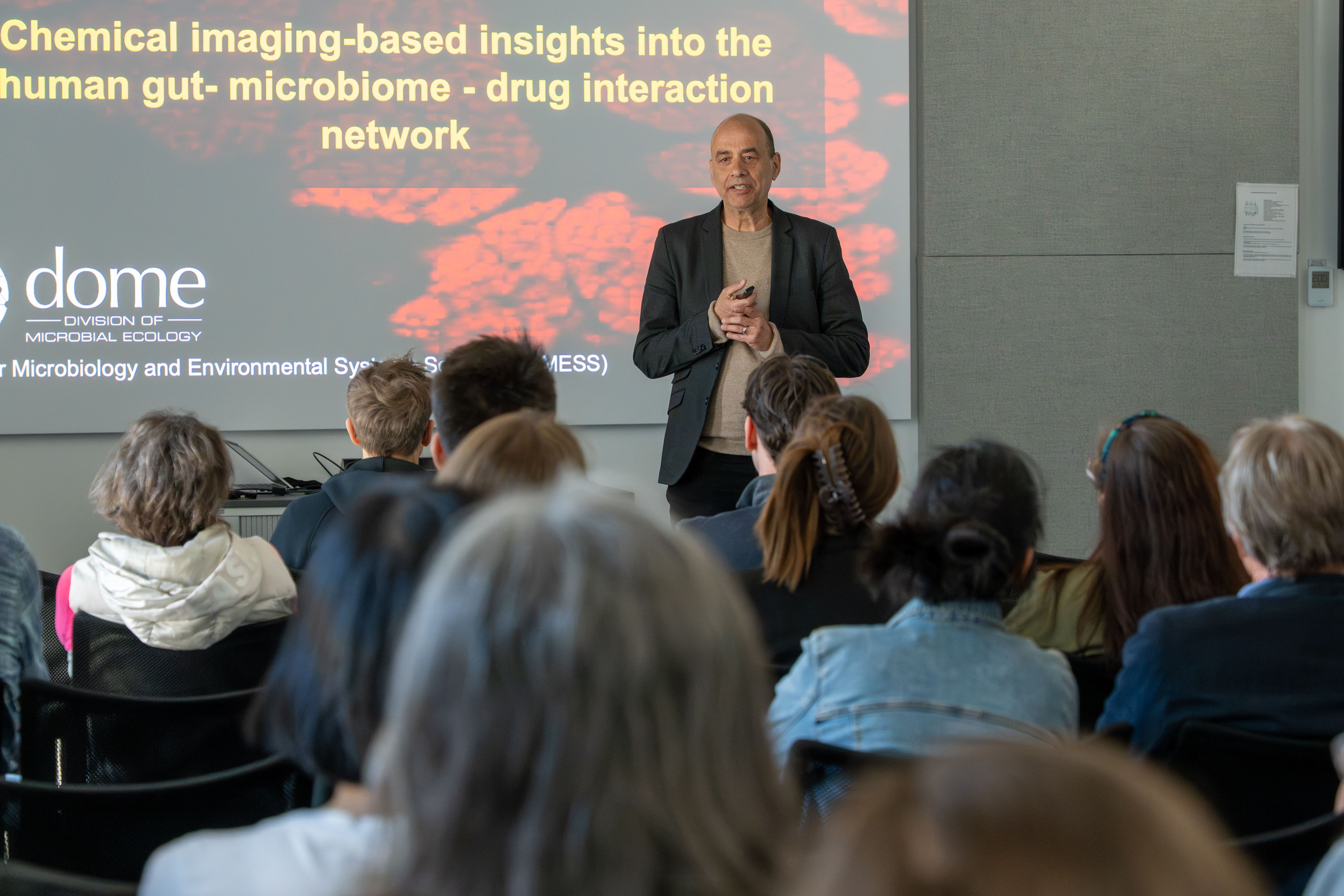
Prof. Dr. Dr. h. c. Michael Wagner talked about chemical imaging-based insights into the human gut microbiome drug interaction network.
One of the biggest challenges in microbiome research is to understand functional properties of microbial community members at single-cell resolution. Single-cell isotope probing has emerged as a powerful approach for this purpose, but current methods for detecting isotope incorporation into single cells remain too slow for high-throughput analyses. Recently, he and his research developed an imaging-based approach termed stimulated Raman scattering–two-photon fluorescence in situ hybridization (SRS-FISH) for high-throughput analysis of microbial metabolism and identity at single-cell resolution (Ge et al. 2022; PNAS). SRS-FISH achieves imaging speeds of 10–100 ms per cell, two to three orders of magnitude faster than state-of-the-art methods.
He also talks about how his research has applied SRS-FISH together with quantitative microbiome profiling and long-read metagenomics to investigate the effects of nervous system–targeted drugs on the human gut microbiome. Specifically, entacapone was studied, a catechol-O-methyltransferase inhibitor widely used in Parkinson’s disease therapy, and loxapine succinate, an antipsychotic used to treat schizophrenia and acute agitation (Pereira et al. 2024; Nat. Microbiol.). Ex vivo supplementation of physiologically relevant concentrations of either drug to faecal samples significantly affected the abundance of up to one third of the microbial species present. Importantly, SRS-FISH revealed that drug-induced effects on microbial metabolism are substantially stronger than effects on species abundances, with low drug concentrations reducing the activity, but not the abundance, of key microbiome members such as Bacteroides, Ruminococcus, and Clostridium species. Mechanistically, it was shown that entacapone perturbs microbial communities through its ability to complex and deplete ferric iron, and that microbial growth can be restored by replenishing microbiota-accessible iron. Notably, entacapone-induced iron starvation selectively enriched iron-scavenging organisms carrying antimicrobial resistance and virulence genes. In addition, he presented unpublished data on the effects of Parkinson’s disease drug combinations on the human gut microbiome, as well as studies in a mouse model examining how entacapone - either directly or via microbiome-mediated mechanisms - affects host immune responses. Together, these results demonstrate the power of next-generation chemical imaging to uncover drug-microbiome-host interactions and identify metal sequestration as an important mechanism of drug-induced microbiome disturbance.
 Copyright: Jonas Ritz/CMFI, University of Tübingen
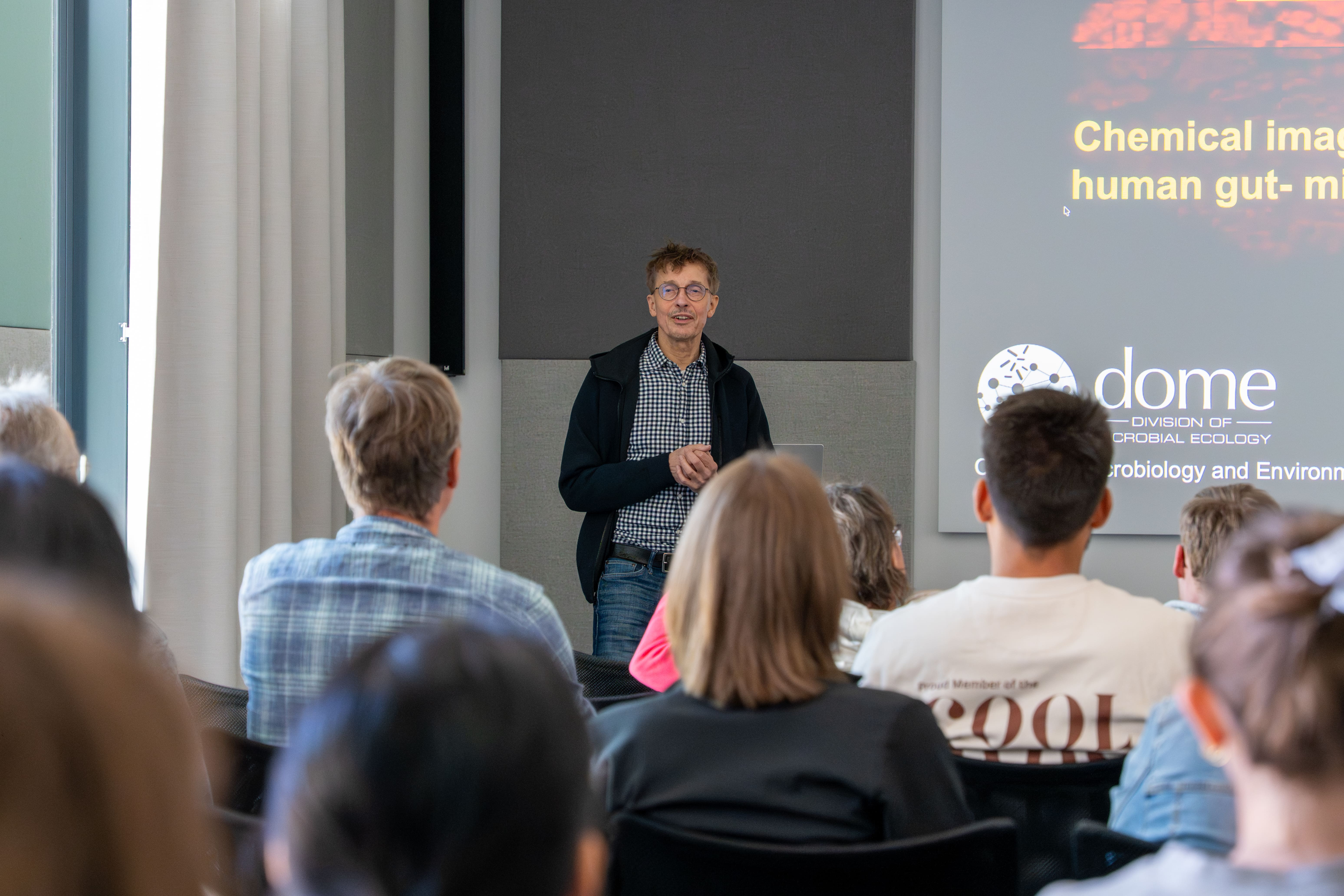
Thereafter, Dr. Christoph Ratzke addressed sublethal antibiotics and how these reshape communities to favor pathogens.
Antibiotic susceptibility is typically measured using pathogens grown in isolation, even though infections occur within complex microbial communities. Here, it was demonstrated that sublethal antibiotic concentrations can paradoxically increase pathogen growth within microbial communities, despite inhibiting the same pathogens in monoculture. This effect arises because antibiotics reshape community composition by preferentially inhibiting strongly suppressive strains and by altering microbial interactions, making them more facilitative. Together, these changes weaken colonization resistance and support pathogen expansion. Importantly, he demonstrated that this effect can translate into increased host lethality following antibiotic treatment. The results of his research highlights that antibiotic efficacy depends strongly on microbial community context.
Find out more about The CMFI: https://www.cmfi.uni-tuebingen.de/
Find out more about Prof. Dr. Dr. h. c. Michael Wagner and his research: https://dome.univie.ac.at/wagner
Find out more about Dr. Christoph Ratzke and his research: https://www.cratzke.de/
Find similar Colloquia: https://www.cmfi.uni-tuebingen.de/colloquium