The group of Dr. Christoph Trautwein published a new Research Square Paper
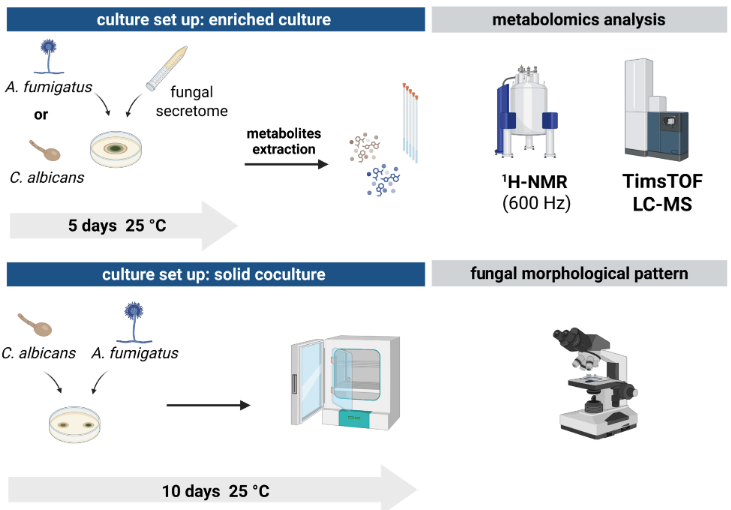
The group of Dr. Christoph Trautwein, together with colleagues from the M3 Research Center, Department of Preclinical Imaging and Radiopharmacy (Sophie Tonneau and Dr. Beziere) and the Université Bourgogne Franche-Comté, published a new Research Square Paper in preprint, titled “Elucidation of the secretory crosstalk between the pathogens Candida albicans and Aspergillus fumigatus via multimodal metabolomics”. Using Advanced metabolomics tools by timsTOF LC-MS and NMR, first author Sophie Tonneau investigated how two major fungal pathogens, namely Candida albicans and Aspergillus fumigatus, interact when they occupy the same environment.
The study suggests these fungi do not simply coexist. Instead, they exchange chemical signals and metabolites that can alter growth, stress responses, toxin production, and potentially disease severity in vulnerable patients. The team found evidence of both competition and cooperation between the fungi. One fungus appeared capable of suppressing certain toxins produced by the other, yet both organisms could still survive together and form mixed communities that may be harder to treat.
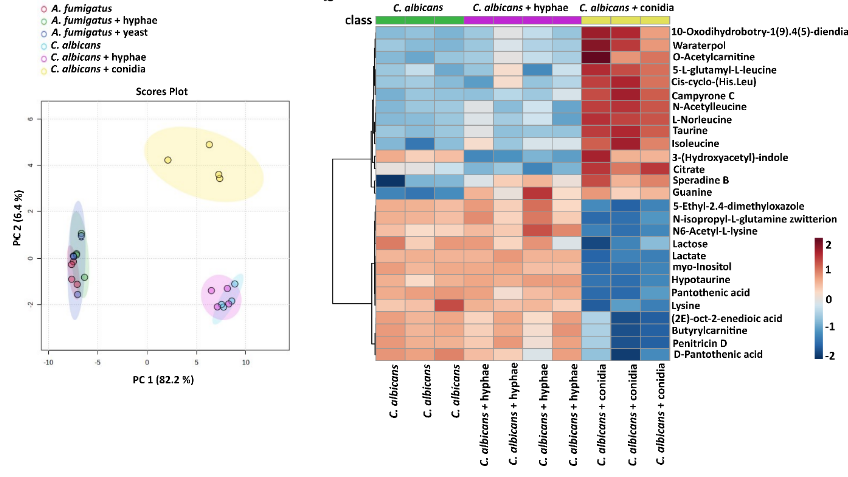
Using a unique multimodal metabolomics approach, the researchers identified 176 compounds involved in this fungal “crosstalk”, including several medically important mycotoxins and inflammation-associated metabolites.
During this research, some major findings were that metabolites secreted by one fungus could dramatically alter the metabolism of the other. This suggests fungal pathogens may actively sense and respond to nearby competitors. Moreover, it was seen that several A. fumigatus mycotoxins decreased when exposed to C. albicans secretions which hints that Candida may partially counteract some toxic behaviors of Aspergillus. Inhibitation zones, fragmented fungal hyphae and signs of metabolic stress were observed in coculture experiments. Yet both fungi still survived together. That means the relationship may be antagonistic without fully eliminating either organism. The researchers identified metabolites associated with inflammation, pneumonia severity, biofilm formation and tissue damage. They suggest these chemical interactions may help create persistent, treatment-resistant infections, especially in immunocompromised patients. The study also points to the possibility that one fungus may help to create conditions that allow the other to thrive.
Both Candida albicans and Aspergillus fumigatus are classified by the WHO as critical-priority fungal pathogens. But most infection research still studies these organisms separately. This work suggests that fungal pathogens may behave very differently when they interact together inside the body. The findings also reinforce the growing idea that infections should sometimes be viewed as microbial ecosystems rather than single-organism diseases.
The work opens a new window into polymicrobial fungal disease and could eventually help researchers to identify new therapeutic targets or diagnostic biomarkers for deadly coinfections.
Find out more about Dr. Christoph Trautwein and his research at the M3 Research Center: https://www.medizin.uni-tuebingen.de/de/das-klinikum/einrichtungen/zentren/m3/metabolomics-and-systems-medicine
Reference:
Sophie Tonneau, Denis Ispan, Gyuntae Bae et al. Elucidation of the secretory crosstalk between the pathogens Candida albicans and Aspergillus fumigatus via multimodal metabolomics, 21 April 2026, PREPRINT (Version 1) available at Research Square https://doi.org/10.21203/rs.3.rs-9059703/v1Sophie Tonneau, Denis Ispan, Gyuntae Bae et al. Elucidation of the secretory crosstalk between the pathogens Candida albicans and Aspergillus fumigatus via multimodal metabolomics, 21 April 2026, PREPRINT (Version 1) available at Research Square [https://doi.org/10.21203/rs.3.rs-9059703/v1]Sophie Tonneau, Denis Ispan, Gyuntae Bae et al. Elucidation of the secretory crosstalk between the pathogens Candida albicans and Aspergillus fumigatus via multimodal metabolomics, 21 April 2026, PREPRINT (Version 1) available at Research Square [https://doi.org/10.21203/rs.3.rs-9059703/v1]Sophie Tonneau, Denis Ispan, Gyuntae Bae et al. Elucidation of the secretory crosstalk between the pathogens Candida albicans and Aspergillus fumigatus via multimodal metabolomics, 21 April 2026, PREPRINT (Version 1) available at Research Square [https://doi.org/10.21203/rs.3.rs-9059703/v1]Sophie Tonneau, Denis Ispan, Gyuntae Bae et al. Elucidation of the secretory crosstalk between the pathogens Candida albicans and Aspergillus fumigatus via multimodal metabolomics, 21 April 2026, PREPRINT (Version 1) available at Research Square [https://doi.org/10.21203/rs.3.rs-9059703/v1]