New Cell Systems Paper by the group of Hannes Link
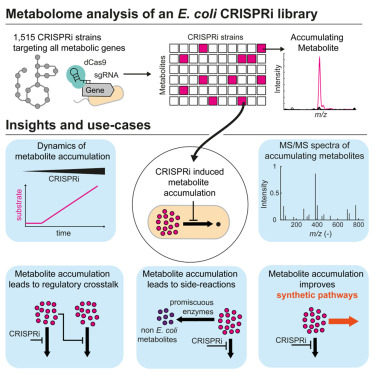
Researchers of the Link Lab developed a new way to study metabolism across an entire cell in much greater detail than before. By combining genome-scale CRISPR interference with global metabolite measurements, they analyzed over 1,500 genetically modified E. coli strains, each with a different metabolic gene suppressed.
Their work addresses a long-standing question: why most metabolites inside cells exist at extremely low levels. The results show that this is not due to technical limitations but is actively controlled by the cell. When certain genes were repressed, metabolites that are usually hardly measurable quickly accumulated and gave clear signals. This indicates that cells intentionally keep these molecules at low levels because higher concentrations are problematic, for example by inhibiting enzymes or causing unwanted side-reactions.
In addition to this biological insight, the team significantly expanded the number of metabolites that can be measured at once and generated new reference data to improve future analyses. Overall, the study demonstrates that metabolism can now be systematically manipulated and observed at scale, offering new opportunities for both basic research and metabolic engineering.
Read more about this publication: https://www.cmfi.uni-tuebingen.de/en/news-events/news/a-new-standard-for-metabolomics
Reference:
Rapp, Johanna et al. “The metabolome of an E. coli CRISPRi library identifies benefits of minimal metabolite levels and targets for engineering.” Cell systems, 101518. 5 Mar. 2026, https://doi.org/10.1016/j.cels.2025.101518