Diving into Single-Cell Sequencing: Why your first step should be a pilot!
Diving into Single-Cell Sequencing: Why your first step should be a pilot!
You need to investigate your research hypothesis using single-cell or single-nucleus RNA sequencing? Welcome! These methods are powerful technologies providing detailed insights into the unique transcriptional profiles of individual cells. However, as a genomics core facility, we often see enthusiastic researchers jump straight into their main experiments, only to encounter easily avoidable pitfalls.
Like in many other assays, many sources of failure in single-cell experiments are only visible downstream, when it is already too late to fix them computationally or experimentally. High-quality single-cell data is built upstream, through careful preparation, and it cannot be rescued downstream by sequencing depth or analysis tricks.
This brings us to the golden rule of experimental design: Run a pilot experiment first to validate your protocol.
Why "user optimization" matters
You might have a flawless, peer-reviewed protocol, but that doesn't guarantee instant success. As described in much detail in the BD Biosciences best practice guide for single cell sequencing (LINK): “Sometimes experiments fail because the protocol isn't well optimized. However, quite often experiments fail because the user is not optimized enough for the protocol. Read it, read it again, then mind-rehearse it, do a full dry run, and only then go to the bench.”. A pilot is not a waste of time or reagents; it is a critical rehearsal. You should dry-run the sample prep protocol until you are fluent before touching your precious samples.
What your pilot should evaluate
An informative dataset requires viable cells or nuclei to begin with. Reviewing established vendor guidelines such as 10x Genomics (LINK), ParseBio (LINK) or other (Illumina, MGI,...) will help you to define reasonable thresholds. When running your pilot, focus on optimizing these core parameters:
Viability: The ideal sample viability should be between 70% and 90%, with intact cell morphology. In fact, aiming for at least 80% viability is a standard best practice— the higher the better.
Debris and aggregation: A viable single-cell suspension must have minimal cell clumping and debris. Your pilot will help you test washing and filtering steps to achieve a clean suspension.
Cell counting: Accurate cell counting is critical before proceeding, as it ensures a successful experiment. We strongly advised to count cells in the NGS labs and to not only rely on FACS sorter count.
Dissociation dynamics: Optimize the sample preparation procedure and evaluate yield, viability, and levels of aggregation before running a specific cell or tissue type for the first time. Treat enzyme, temperature, and timing as critical dissociation variables.
Use the best methodology for your needs
One of the first choices in your pilot is whether to sequence whole cells or isolated nuclei. This decision depends heavily on your tissue type and research question:
Whole Cells
Pros: Captures the full transcriptome, including cytosolic RNA, and is essential for studying cell surface proteins, CRISPR, or V(D)J profiles.
Cons: Dissociation can be harsh, inducing stress responses that distort biology. Some tissues (brain, skin, fibrous tumors) are notoriously difficult to dissociate without high cell death.
Single Nuclei
Pros: Invaluable for "difficult" tissues or clinical samples that must be frozen immediately. It bypasses cell size restrictions of certain technologies and minimizes transcriptional changes during processing.
Cons: You lose cytosolic RNA. Furthermore, isolated nuclei are fragile and cryopreserving them is complex.
During your pilot, you aren’t just testing your sample; you are testing which technology fits your project's constraints. Depending on your cell type, throughput needs, and logistics, different methods offer unique advantages:
Droplet-based Encapsulation (Microfluidics): Is currently the most widely used method because it is high-throughput, highly automated, and offers standardized workflows. However, this automation using microfluidic hardware can be sensitive to debris and "clumpiness." A clog can compromise sample quality (loss of complete sample, reduce the number of cells…) , and these systems require fresh and high-quality samples to prevent ambient RNA from creating high background noise in your data.
Split-Pool Combinatorial Barcoding: Takes a different approach by using the cell (or nucleus) itself as the reaction vessel. By "splitting and pooling" samples across plates to add barcodes, it removes the need for specialized hardware. This method’s greatest strength is the generation of fixed cells and nuclei suspensions, allowing you to store and process up to 96 samples simultaneously, which effectively reduces technical batch effects. The downside is the human factor; it involves significantly more manual lab work and intensive pipetting steps compared to automated platforms.
Microwell-based Capture: Relies on gravity to settle cells into microscopic wells. This is often much gentler for large or fragile cells that might be damaged by the pressure of microfluidic channels and also show some of the highest capture rates. However, because it relies on the physical dimensions of the wells, it generally offers lower throughput in terms of the total number of cells processed per run.
Plate-based: Involve sorting single cells into individual wells of a plate. While this is the most expensive and time-consuming route, it provides the highest sensitivity and full-length transcript coverage. It is the gold standard for studying rare cell populations or looking at alternative splicing. The main drawback is the scale; it is a low-throughput method that is often cost-prohibitive for large discovery-based studies.
Creating the best conditions for a successful experiment requires some trial and error. Always align with a bioinformatician and your core facility before you begin. Adequate preparation can simplify the most challenging aspects of sample prep and be the difference between bad data and exceptional data.
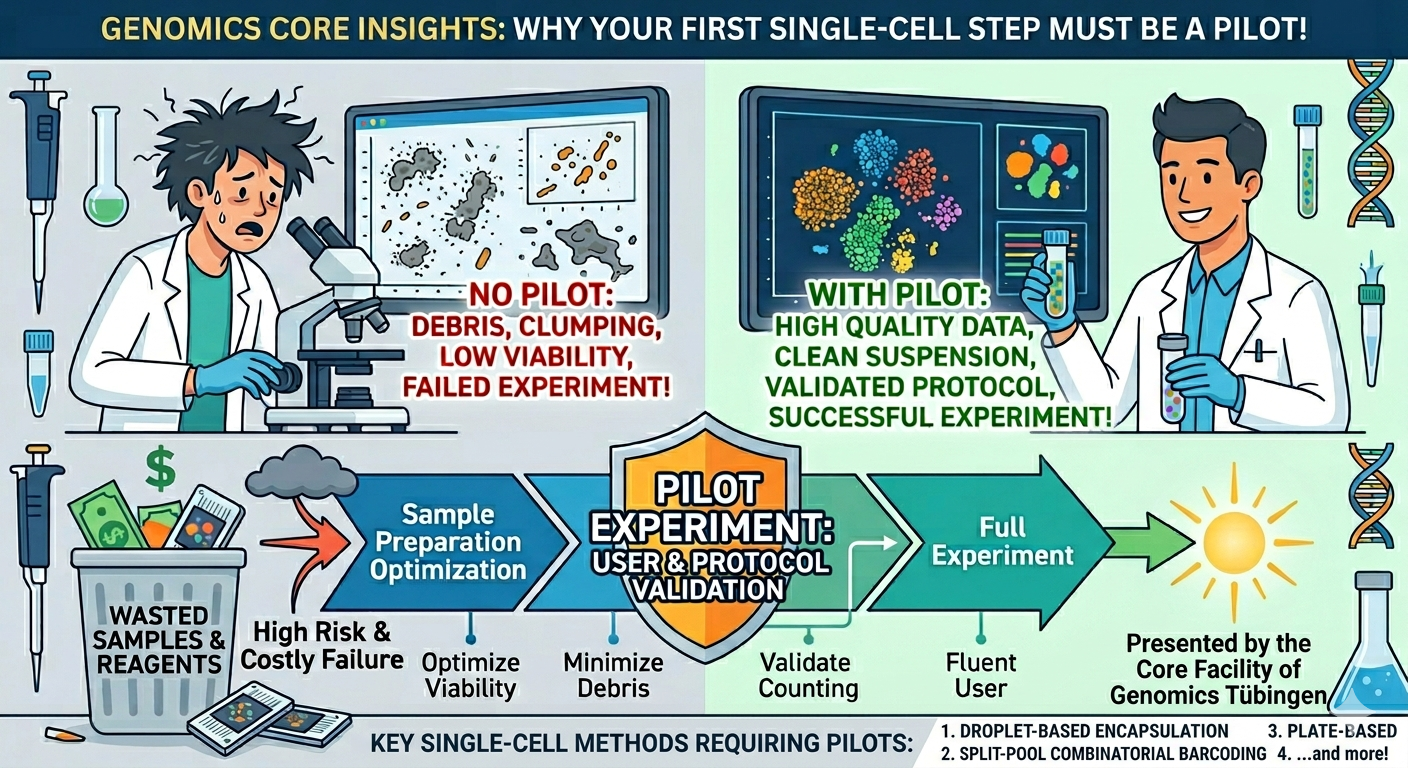 Single-cell and single-nucleus RNA sequencing are powerful tools for uncovering unique cellular profiles, but their success depends entirely on high-quality sample preparation that cannot be fixed by downstream analysis. Researchers are encouraged to prioritize a pilot experiment as a critical rehearsal to optimize cell viability, minimize debris, and refine dissociation dynamics before handling precious samples.