Prof. Dr. Manfred Claassen hosts a Spatial Biology Day at the Universitätsklinikum Tübingen
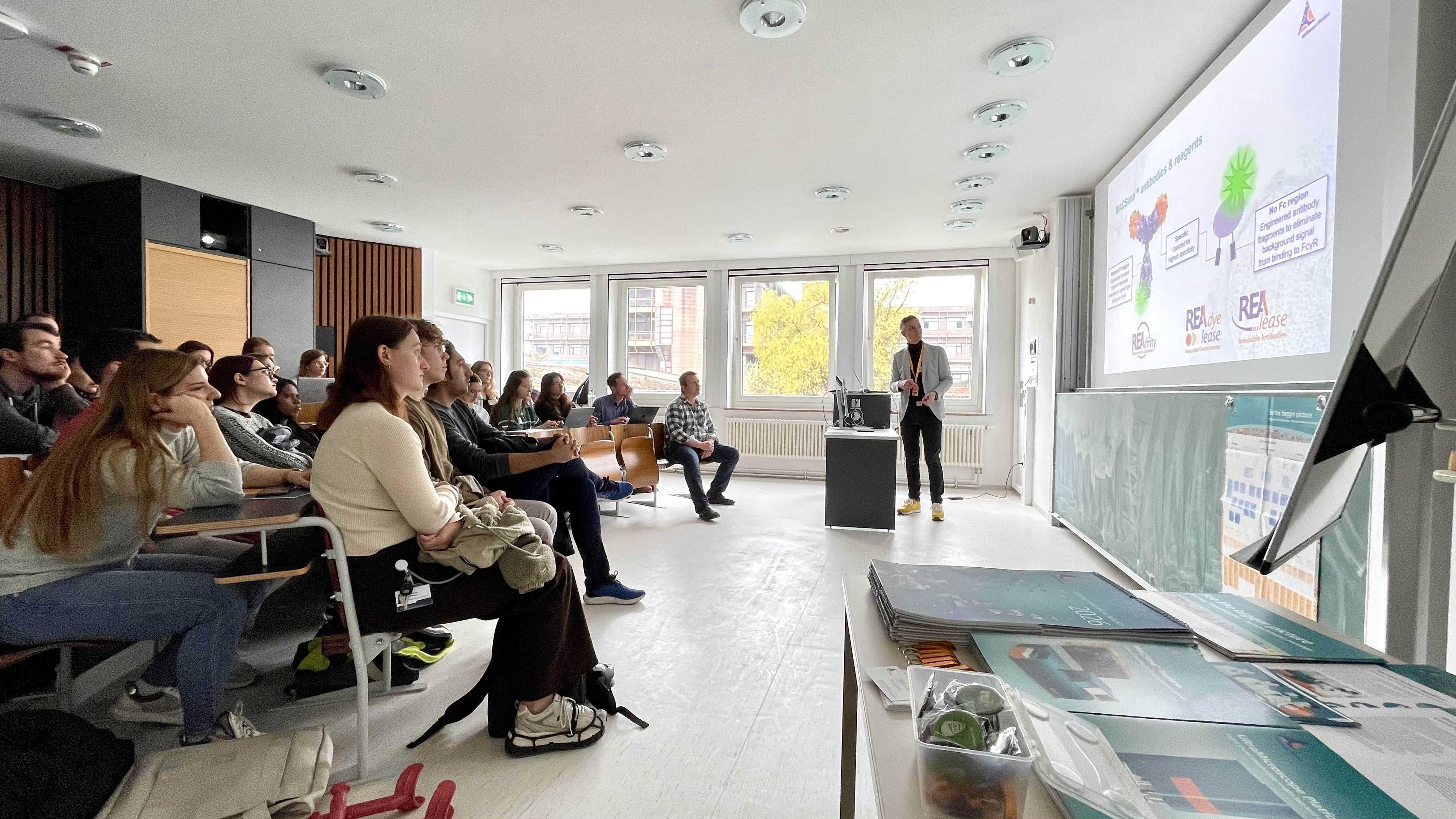
Researchers, clinicians, and industry experts gathered at the Universitätsklinikum Tübingen for a focused and forward-looking event: Spatial Biology Day in Tübingen. Hosted by Prof. Dr. Manfred Claassen and his research group at the M3 Research Center, the event highlighted the growing importance of spatially resolved biological analysis in modern biomedical research.
From the very beginning, it was clear that spatial biology is no longer a niche discipline. Instead, it is rapidly becoming central to how we understand complex tissue systems, disease progression, and therapeutic response.
The day opened with a presentation by Dr. Oliver Petters from Miltenyi Biotec, who introduced the capabilities of the MACSima Platform. His talk emphasized how high-dimensional imaging technologies are enabling researchers to explore tissue architecture at an unprecedented level of detail. Rather than studying cells in isolation, scientists can now examine how they interact within their native environments—a shift that is redefining experimental design across the life sciences.
This theme carried into the next session, where Dr. Sophia Scheuermann presented on visualizing cancer through functional phenotyping. Her work demonstrated how spatial context can directly inform precision immunotherapy strategies. By mapping immune cell behavior within tumors, researchers are uncovering patterns that were previously invisible, yet critically important for treatment outcomes.
Following this, Prof. Claassen himself took the stage to discuss computational approaches to identifying disease-associated tissue microenvironments. His presentation blended machine learning with biological insight, illustrating how both supervised and unsupervised methods can reveal hidden structure in complex datasets. It was a reminder that spatial biology is not only about imaging, it is equally about making sense of the vast data those images generate.
After a lively lunch session, which encouraged informal discussion and direct exchange with experts, the program continued with a series of applied perspectives. Dr. Annekathrin Reinhardt explored multiplex immunofluorescence techniques for analyzing tumor microenvironments and signaling pathways in FFPE tissue samples. Her talk highlighted the practical challenges and opportunities of translating spatial biology into clinically relevant workflows.
The event concluded with a broader industry perspective from Vicinity Bio GmbH, focusing on end-to-end pipelines for multiplexed tissue imaging. The question they posed, whether fully integrated “sample-to-discovery” solutions are within reach, sparked discussion about the future direction of the field.
Throughout the day, one thing became increasingly evident: spatial biology sits at the intersection of technology, computation, and medicine. It demands collaboration across disciplines, and events like this provide a valuable platform for exactly that.
For the M3 Research Center, hosting this event reflects a continued commitment to advancing data-driven, systems-level understanding of biology. With Prof. Claassen’s group actively contributing to this evolving landscape, Tübingen is well positioned as a hub for innovation in spatial and computational biology.
As the field continues to mature, the conversations started here will likely shape not only future research projects, but also the next generation of diagnostic and therapeutic approaches.
Find out more about Prof. Dr. Manfred Claassen and his research group: https://www.medizin.uni-tuebingen.de/de/das-klinikum/einrichtungen/zentren/m3/rare-cell-populations and https://claassenlab.github.io/