
Das Klinikum
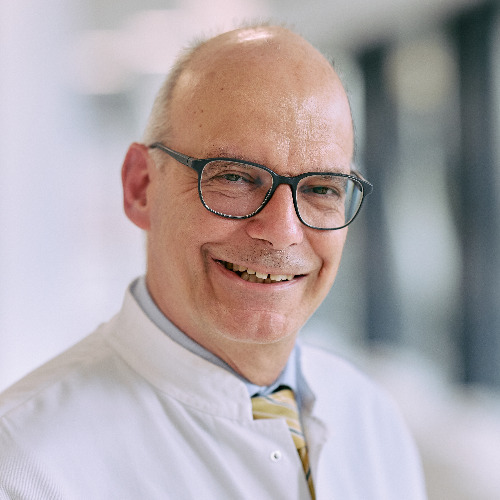
Prof. Dr. Ulf Ziemann
Ärztlicher Direktor
Ärztlicher Direktor der Abteilung Neurologie mit Schwerpunkt neurovaskuläre Erkrankungen, Klinik für Neurologie
Facharzt für Neurologie
Zusatzbezeichnung Intensivmedizin (Neurologie)
Ko-Direktor Hertie-Institut für Klinische Hirnforschung (HIH)
Kontakt
Telefonnummer: 07071 29-82049
Faxnummer: 07071 29-5260
E-Mail-Adresse: ulf.ziemann@med.uni-tuebingen.de
Klinik / Institut / Zentrum
Klinische Schwerpunkte
- Neurovaskuläre Medizin
- Neuroimmunologie
- Neurologische Intensivmedizin
- Klinische Neurophysiologie
Wissenschaftliche Tätigkeit
- Deputy-Editor "Brain Stimulation", https://ees.elsevier.com/brs/; Past-Editor-in-Chief "Clinical Neurophysiology" (2016-2023), https://www.clinph-journal.com/
- Leiter der Arbeitsgruppe "Brain Networks & Plasticity"
- Leiter des vom Europäischen Forschungsrat geförderten Synergy-Projektes "ConnectToBrain"
Aktuelle Forschungsvorhaben / Drittmittelprojekte
- Brain-oscillation-synchronized stimulation to enhance motor recovery in early subacute stroke: A randomized controlled double-blind threearm parallel-group exploratory trial comparing personalized, non-personalized and sham repetitive transcranial magnetic stimulation (BOSS-STROKE), funded by the BMBF (2021-2027)
- ROBotic MIrrored Therapy after stroke (ROBMIT), funded by the Else-Kröner-Fresenius Foundation (EKFS) (2022-2027)
- Transcranial brain stimulation to study memory processing and synaptic plasticity during sleep, funded by German Research Foundation (DFG, FOR 5434), 2022-2026
- CLOsing the loOP on non-invasive brain sTiMulation with deep neural networkS (LOOP-TMS)
ERC-Grant
-
ConnectToBrain
ERC Synergy Grant
ConnectToBrain will introduce whole-brain multi-locus transcranial magnetic stimulation (mTMS), in which
the brain-stimulating electric-field location, direction, magnitude and timing are controlled electronically
based on real-time high-density electroencephalography (hdEEG) information of activity and connectivity in
brain networks. The final mTMS apparatus will consist of 50 coils. Superpositions of electric fields produced
by the different overlapping coils allow spatiotemporally millimeter- and millisecond-precise stimulus
sequences to arbitrary cortical sites without physical movements of the coil set. Spatial targeting of mTMS
will be further improved by measuring individual brain conductivity distributions with ultra-low-field MRI.
The proposed hdEEG methodology uses a brain–computer interface (BCI) and a computer–brain interface
(CBI) in a closed, algorithmically-controlled loop. BCI receives real-time information about brain activity
and connectivity from hdEEG, while CBI adapts mTMS to drive brain activity and connectivity into desired
directions. ConnectToBrain will allow unprecedented tracking of dynamic changes and reorganization of
brain networks in real time, and network-targeted closed-loop stimulation. This radically novel technology
will cause a paradigm shift from current open-loop practice that is only moderately effective in therapy. We
will apply ConnectToBrain to reach new levels of efficacy of therapeutic applications. Patients after stroke
and with Alzheimer’s disease will be tested and treated as models of network disorders.
Our high-risk, high-gain endeavor will reach the ambitious goals only through the Synergy of the 3 PIs,
world leaders in their complementary areas of expertise (instrumentation, algorithms, translation). If
ConnectToBrain succeeds, we expect the value of societal, health and industrial benefits in Europe to exceed
€1 billion annually, not to mention the immense value of alleviating human suffering from brain disorders.Laufzeit: 2019-2027
Fördersumme: 10.000.000 €
Ausbildung & beruflicher Werdegang
-
seit 05/2012Ärztlicher Direktor der Abteilung Neurologie mit Schwerpunkt vaskuläre Neurologie und Neuroonkologie, Universitätsklinikum Tübingen
-
12/2004-04/2012Leitender Oberarzt, Personaloberarzt und Stellvertreter des Direktors der Klinik für Neurologie, Goethe-Universität Frankfurt
-
04/2000-11/2004Oberarzt. Klinik für Neurologie, Goethe-Universität Frankfurt
-
09/1999-03/2000Assistenzarzt. Klinik für Neurologie, Goethe-Universität Frankfurt
-
11/1996-08/1999DFG-Forschungsstipendiat. National Institute of Neurological Disorders and Stroke, NIH, USA
-
10/1993-10/1996Assistenzarzt. Abteilung für Klin. Neurophysiologie, Zentrum Neurologie, Uniklinik Göttingen
-
07/1993-09/1993Gastwissenschaftler. Human Movement & Balance Unit, The Institute of Neurology, Queen Square, London
-
01/1992-07/1993Wissenschaftlicher Mitarbeiter (AiP). Neurologisches Therapiecentrum (NTC), Institut an der Heinrich-Heine Universität Düsseldorf
-
07/1991-12/1991Wissenschaftlicher Mitarbeiter (AiP), Abteilung Neurobiologie, Max-Planck-Institut für Biophysikalische Chemie, Göttingen
-
10/1984-05/1991Studium der Humanmedizin in Göttingen und London
Preise & Auszeichnungen
- Clarivate Web of Science Highly Cited Researcher 2018, 2020-2025
- 2014-2022: gelistet in „Beste Ärzte“ des Verbrauchermagazins Guter Rat; 2022-2025: Focus Top Mediziner
- Skou Honorar-Professor Universität Aarhus (2026-2030)
Publikationen
- >590 begutachtete Publikationen, >87.500 Zitationen, h-Index 138 (Google Scholar); https://pubmed.ncbi.nlm.nih.gov/?term=ziemann+u&sort=date&size=100
- Publikationen
Mitgliedschaften
- European Stroke Organization (ESO)
- Deutsche Schlaganfallgesellschaft (DSG)
- Deutsche Gesellschaft für Klinische Neurophysiologie und Funktionelle Bildgebung (DGKN)
- Deutsche Gesellschaft für Neurologie (DGN)
- Deutsche Gesellschaft für NeuroIntensiv- und Notfallmedizin (DGNI)