
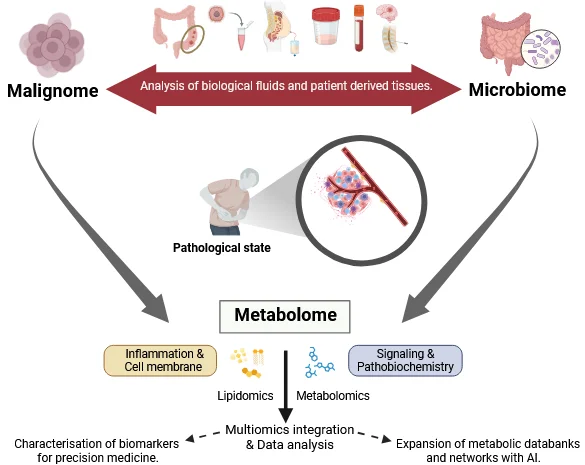
Our research focus is spatial and functional metabolomics to understand the role and impact of small molecules (metabolites, lipids, drugs, nutrients, exposures) on the local (tissue) and systemic level (biofluids). For that we use analytical technologies being based on Nuclear Magnetic Resonance (NMR), liquid chromatography mass spectrometry (LC-MS) and mass spectrometry imaging (MSI). Our analytical platforms represent the latest state of the art: quantitative IVDr (vitro diagnostics research) NMR, trapped ion mobility spectrometry time of flight (timsTOF) LC-MS and single cell MSI MALDI Imaging. The combination of these different approaches enables us to achieve a maximum metabolome and lipidome coverage in order to perform robust pathway and biomarker analysis. In here, we are specifically interested how abnormal concentrations of small molecules (including microbial metabolites) interact with the tissue microenvironment and how they impact endogenous metabolic pathways, affect cellular homeostasis and finally contribute to the onset of diseases. By mapping multimodal metabolomics and lipidomics data with gene expression and spatial metabolomics with other omics layers and histopathology, this helps us to better understand diseases like endometriosis, different solid cancers and neurodegenerative disorders and to identify new treatment targets or biomarker candidates.
Functional and Spatial Metabolomics

Head of Core Facility Metabolomics, Research Group Leader WSIC/M3
Publikationen: ORCID Profile
Publikationen: Web of Science
Biosketch
Christoph Trautwein finished his first degree at the University Stuttgart in 2006 as environmental engineer (Dipl.-Ing.) where he specialized in analytical chemistry and environmental microbiology. Awarded with a scholarship from the German Environmental Agency (DBU) he started his PhD in 2007 at the University of Freiburg in collaboration with the University Hospital Freiburg. Herein he investigated the microbial degradation and distribution of drugs in the aquatic environment by LC-MS. Fascinated by the potential use of advanced analytical chemistry within clinical research, he started a second career in Molecular Medicine. He obtained his doctor title in 2012 (Dr. rer. nat.) and graduated in 2014 as Dipl. mol. med. at the University of Freiburg. In order to expand his analytical knowledge towards NMR spectroscopy, he was working from 2015-2016 at the Karlsruhe Institute for Technology (KIT) as postdoc for NMR based metabolomics. In 2017, he joined the WSIC at the University Hospital Tübingen and built up the research field of preclinical and clinical metabolomics. Since 2019 he is heading his own research group and since 2022, he started to build up the Core Facility Metabolomics at the M3 Center which he leads since 2024. Currently he is in process of finalizing his habilitation and further pushing the boundaries of multimodal metabolomics, using latest state-of-the art analytical instrumentation being based on NMR, LC-MS and MALDI Imaging for basic pre/clinical research and personalized precision medicine.

Interview

Metabolomics & Systems Medicine – Interview with Dr. Christoph Trautwein
Join Dr. Christoph Trautwein and his research group as they dive into how advanced analytical techniques – like mass spectrometry, chromatography and NMR spectroscopy – are revolutionizing our understanding of metabolism in health and disease. From sample prep to statistical analysis, discover how their expertise in metabolomics and lipidomics is driving personalized medicine and contributing to cutting-edge projects in cancer, neurology, immunology, metabolic disorders and cardiovascular disease. Learn how their work with human and murine samples is shaping the future of systems biology – one molecule at a time.
Beim Abspielen des Videos werden Daten an YouTube übertragen. Weitere Hinweise finden Sie in unserer Datenschutzerklärung.
Team

Akademischer Mitarbeiter, Core Facility Metabolomics
Publikationen: Researchgate
Publikationen: ORCID
Core Facility Metabolomics, Akademische Mitarbeiter
Publikationen: LinkedIn profile
PhD Student
E-Mail-Adresse: stefanie.strasser@med.uni-tuebingen.de


ex-vivo tissue
feces/stool and cell culture investigations
two-phase
extraction SOPs for polar and lipid metabolites
analysis
of murine and human biofluids
Selected publications
-
2026
Cross-domain metabolic interactions link Methanobrevibacter smithii to colorectal cancer microbial ecosystems
Mohammadzadeh R, Mahnert A, Zurabishvili T, Wink L, Kumpitsch C, Habisch H, Sprengel J, Filek K, Mertelj P, Pernitsch D, Hingerl K, Durdevic M, Gorkiewicz G, Diener C, Loy A, Kolb D, Trautwein C, Madl T, Moissl-Eichinger C. Cross-domain metabolic interactions link Methanobrevibacter smithii to colorectal cancer microbial ecosystems. Nat Commun. 2026 Feb 20. doi: 10.1038/s41467-026-69711-7. Epub ahead of print. PMID: 41720792. https://doi.org/10.1038/s41467-026-69711-7 -
2026
CAR-adapted PIK3CD base editing enhances T cell anti-tumor potency
Bucher P, Brückner N, Kortendieck J, Grimm M, Schleicher JT, Bartels K, Hardy S, Rausch M, Wurzer H, Thiemann M, May C, Mitstorfer M, Letzgus D, Quach J, Schneider C, Ispan DA, Gonzalez-Menendez I, Jain N, Ho YJ, Chen J, Sánchez-Rivera FJ, Sun J, Quintanilla-Martinez L, Trautwein C, Weigelin B, Claassen M, Sadelain M, Feucht J, Leibold J. CAR-adapted PIK3CD base editing enhances T cell anti-tumor potency. Nat Cancer. 2026 Feb;7(2):368-383. doi: 10.1038/s43018-025-01099-7. Epub 2026 Jan 6. PMID: 41495526; PMCID: PMC12948676. https://doi.org/10.1038/s43018-025-01099-7 -
2025
Cryogenic mouse tissue homogenization as an alternative to fresh-frozen biopsy use for genomics, transcriptomics, proteomics and metabolomics
Zizmare L, Hofmann U, Jarboui MA, Klose F, Fraschka S, Matthes J, Krüger M, Schaeffeler E, Schwab M, Ueffing M, Pichler BJ, Boldt K, Casadei N, Trautwein C. Cryogenic mouse tissue homogenization as an alternative to fresh-frozen biopsy use for genomics, transcriptomics, proteomics and metabolomics. Sci Rep. 2025 Jun 23;15(1):20254. https://doi.org/10.1038/s41598-025-06438-3 -
2025
Identification and impact of microbiota-derived metabolites in ascites of ovarian and gastrointestinal cancer
Deng S, Kim W, Cheng K, Yang Q, Singh Y, Bae G, Bézière N, Mager L, Kommoss S, Sprengel J, Trautwein C. Identification and impact of microbiota-derived metabolites in ascites of ovarian and gastrointestinal cancer. Cancer Metab. 2025 May 13;13(1):21. doi: 10.1186/s40170-025-00391-5. PMID: 40361187; PMCID: PMC12076955. https://doi.org/10.1186/s40170-025-00391-5 -
2024
Retinal metabolism displays evidence for uncoupling of glycolysis and oxidative phosphorylation via Cori-, Cahill-, and mini-Krebs-cycle
Chen Y, Zizmare L, Calbiague V, Wang L, Yu S, Herberg FW, Schmachtenberg O, Paquet-Durand F, Trautwein C. Retinal metabolism displays evidence for uncoupling of glycolysis and oxidative phosphorylation via Cori-, Cahill-, and mini-Krebs-cycle. Elife. 2024 May 13;12:RP91141. doi: 10.7554/eLife.91141. PMID: 38739438; PMCID: PMC11090511. https://doi.org/10.7554/elife.91141 -
2024
Quantitative Metabolomics and Lipoprotein Analysis of PDAC Patients Suggests Serum Marker Categories for Pancreatic Function, Pancreatectomy, Cancer Metabolism, and Systemic Disturbances
Bae G, Berezhnoy G, Flores A, Cannet C, Schäfer H, Dahlke MH, Michl P, Löffler MW, Königsrainer A, Trautwein C. Quantitative Metabolomics and Lipoprotein Analysis of PDAC Patients Suggests Serum Marker Categories for Pancreatic Function, Pancreatectomy, Cancer Metabolism, and Systemic Disturbances. J Proteome Res. 2024 Apr 5;23(4):1249-1262. doi: 10.1021/acs.jproteome.3c00611. Epub 2024 Feb 26. PMID: 38407039; PMCID: PMC11003419. https://doi.org/10.1021/acs.jproteome.3c00611 -
2024
mage-guided metabolomics and transcriptomics reveal tumour heterogeneity in luminal A and B human breast cancer beyond glucose tracer uptake
Yang Q, Deng S, Preibsch H, Schade TC, Koch A, Berezhnoy G, Zizmare L, Fischer A, Gückel B, Staebler A, Hartkopf AD, Pichler BJ, la Fougère C, Hahn M, Bonzheim I, Nikolaou K, Trautwein C. Image-guided metabolomics and transcriptomics reveal tumour heterogeneity in luminal A and B human breast cancer beyond glucose tracer uptake. Clin Transl Med. 2024 Feb;14(2):e1550. doi: 10.1002/ctm2.1550. PMID: 38332687; PMCID: PMC10853679. https://doi.org/10.1002/ctm2.1550 -
2024
A 5:2 intermittent fasting regimen ameliorates NASH and fibrosis and blunts HCC development via hepatic PPARα and PCK1
Gallage S, Ali A, Barragan Avila JE, Seymen N, Ramadori P, Joerke V, Zizmare L, Aicher D, Gopalsamy IK, Fong W, Kosla J, Focaccia E, Li X, Yousuf S, Sijmonsma T, Rahbari M, Kommoss KS, Billeter A, Prokosch S, Rothermel U, Mueller F, Hetzer J, Heide D, Schinkel B, Machauer T, Pichler B, Malek NP, Longerich T, Roth S, Rose AJ, Schwenck J, Trautwein C, Karimi MM, Heikenwalder M. A 5:2 intermittent fasting regimen ameliorates NASH and fibrosis and blunts HCC development via hepatic PPARα and PCK1. Cell Metab. 2024 Jun 4;36(6):1371-1393.e7. doi: 10.1016/j.cmet.2024.04.015. Epub 2024 May 7. PMID: 38718791. https://doi.org/10.1016/j.cmet.2024.04.015 -
2024
Integrative Molecular Structure Elucidation and Construction of an Extended Metabolic Pathway Associated with an Ancient Innate Immune Response in COVID-19 Patients
Sala S, Nitschke P, Masuda R, Gray N, Lawler NG, Wood JM, Buckler JN, Berezhnoy G, Bolaños J, Boughton BA, Lonati C, Rössler T, Singh Y, Wilson ID, Lodge S, Morillon AC, Loo RL, Hall D, Whiley L, Evans GB, Grove TL, Almo SC, Harris LD, Holmes E, Merle U, Trautwein C, Nicholson JK, Wist J. Integrative Molecular Structure Elucidation and Construction of an Extended Metabolic Pathway Associated with an Ancient Innate Immune Response in COVID-19 Patients. J Proteome Res. 2024 Mar 1;23(3):956-970. doi: 10.1021/acs.jproteome.3c00654. Epub 2024 Feb 4. PMID: 38310443; PMCID: PMC10913068. https://doi.org/10.1021/acs.jproteome.3c00654 -
2023
Urinary phenotyping of SARS-CoV-2 infection connects clinical diagnostics with metabolomics and uncovers impaired NAD+ pathway and SIRT1 activation
Lonati C, Berezhnoy G, Lawler N, Masuda R, Kulkarni A, Sala S, Nitschke P, Zizmare L, Bucci D, Cannet C, Schäfer H, Singh Y, Gray N, Lodge S, Nicholson J, Merle U, Wist J, Trautwein C. Urinary phenotyping of SARS-CoV-2 infection connects clinical diagnostics with metabolomics and uncovers impaired NAD+pathway and SIRT1 activation. Clin Chem Lab Med. 2023 Nov 14;62(4):770-788. doi: 10.1515/cclm-2023-1017. PMID: 37955280. https://doi.org/10.1515/cclm-2023-1017